盎 (àng) means "pot / bowl / abundant" in Chinese. It has 10 strokes with the radical 皿.
Rated 4.2/5 in difficulty (advanced).
Appears in 3+ common words including 盎然 (àng rán), 盎盂 (àng yú), 盎中 (àng zhōng).
Due to its 10 strokes, Hanzi Writer's error detection shows 盎 requires focused practice — most learners need 10+ attempts for consistent accuracy.
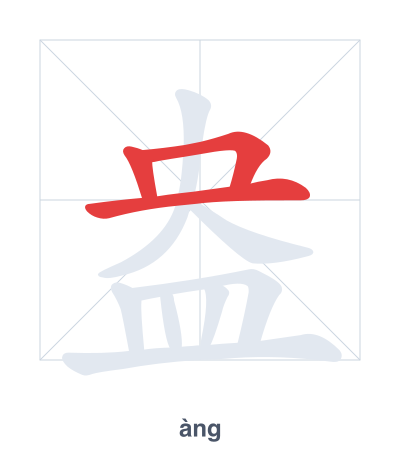
Open Hanzi Writer to see the animated stroke order and practice writing 盎 with real-time feedback.
The character 盎 (àng) is written with 10 strokes. Follow the standard Chinese stroke order: top to bottom, left to right, outside before inside. The radical 皿 is one of its key components.
Practice the correct stroke order with the Hanzi Writer app to see animated stroke-by-stroke guidance with real-time feedback.
盎 means pot / bowl / abundant.
| Character | 盎 |
| Pinyin | àng (ang) |
| Meaning | pot / bowl / abundant |
| Strokes | 10 |
| Radical | 皿 |
| Difficulty | 4.2/5 |
The character 盎 is a phono-semantic compound combining the vessel radical 皿 (a container) with 央 (yāng) as a phonetic component. It originally denoted a large-bellied earthenware pot, and the meaning 'abundant' arose from the image of a vessel filled to overflowing.
💡 Memory Tip: Picture a bowl (皿) with a central mound (央) of rice so abundant it spills over the rim.
公园里春意盎然。
gōng yuán lǐ chūn yì àng rán
The park is full of the breath of spring.
盎盂相击是常有的事。
àng yú xiāng jī shì cháng yǒu de shì
It is common for family members to have friction (literally: for pots and bowls to clash).
盎中盛满了清水。
àng zhōng shèng mǎn le qīng shuǐ
The pot is filled with clear water.
Open Hanzi Writer to see the animated stroke order and practice writing 盎 with real-time feedback.
✨ Animated stroke order · Handwriting recognition · HSK-graded practice · Free to use
盎 is made of two parts: the top is 央 (yāng, meaning center) and the bottom is 皿 (mǐn, meaning vessel). Together, they suggest a vessel that is full in the center, which connects to the meanings "pot" and "abundant."