讶 (yà) means "To be surprised / To be astonished" in Chinese. It has 6 strokes with the radical 讠, and is HSK Level 7.
Rated 2.9/5 in difficulty (moderate).
Harder than 7% of HSK Level 7 characters.
Appears in 3+ common words including 惊讶 (jīng yà), 讶异 (yà yì), 惊讶不已 (jīng yà bù yǐ).
Hanzi Writer's stroke validation shows learners typically need 5-8 attempts to write 讶 with correct proportion and order.
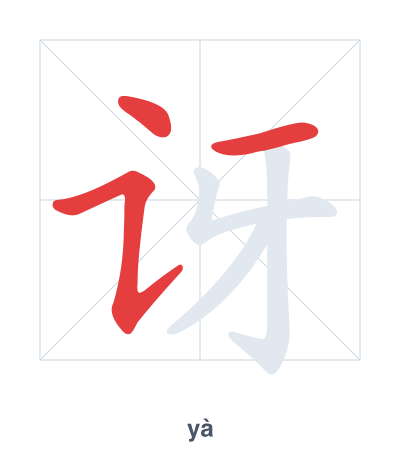
Open Hanzi Writer to see the animated stroke order and practice writing 讶 with real-time feedback.
The character 讶 (yà) is written with 6 strokes. Follow the standard Chinese stroke order: top to bottom, left to right, outside before inside. The radical 讠 is one of its key components.
Practice the correct stroke order with the Hanzi Writer app to see animated stroke-by-stroke guidance with real-time feedback.
讶 means To be surprised / To be astonished.
As an HSK Level 7 character, 讶 is an intermediate-level character.
讶 combines the speech radical 讠 with 牙 (tooth), suggesting the idea of opening one's mouth wide enough to show teeth in surprise. The character originally conveyed a startled exclamation, linking speech and a visible reaction of astonishment.
💡 Memory Tip: Picture someone gasping "Ya!" in shock, their mouth open wide enough to show all their teeth (牙), which are captured by the speech bubble (讠).
听到这个消息我很惊讶。
tīng dào zhè ge xiāo xī wǒ hěn jīng yà
I was very astonished to hear this news.
他的反应让人感到讶异。
tā de fǎn yìng ràng rén gǎn dào yà yì
His reaction was surprising.
大家都对他惊讶不已。
dà jiā dōu duì tā jīng yà bù yǐ
Everyone was amazed by him.
Open Hanzi Writer to see the animated stroke order and practice writing 讶 with real-time feedback.
✨ Animated stroke order · Handwriting recognition · HSK-graded practice · Free to use
The character 讶 consists of the speech radical 讠 on the left and the component 牙 (tooth or fang) on the right. The speech radical suggests an exclamation or spoken reaction, while 牙 hints at a sharp, sudden intake of breath — like when you gasp in surprise.