异 (yì) means "different; strange; unusual" in Chinese. It has 6 strokes with the radical 廾, and is HSK Level 6.
Rated 3.2/5 in difficulty (challenging).
Harder than 13% of HSK Level 6 characters.
Appears in 3+ common words including 异常 (yì cháng), 差异 (chā yì), 异同 (yì tóng).
Due to its 6 strokes, Hanzi Writer's error detection shows 异 requires focused practice — most learners need 10+ attempts for consistent accuracy.
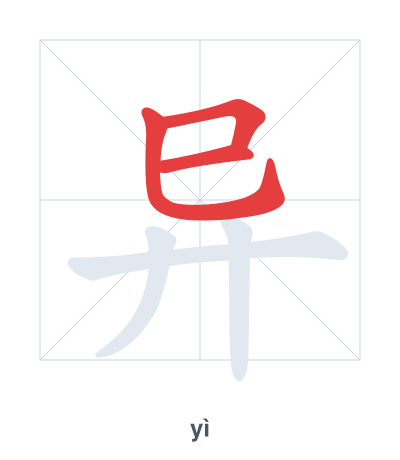
Open Hanzi Writer to see the animated stroke order and practice writing 异 with real-time feedback.
The character 异 (yì) is written with 6 strokes. Follow the standard Chinese stroke order: top to bottom, left to right, outside before inside. The radical 廾 is one of its key components.
Practice the correct stroke order with the Hanzi Writer app to see animated stroke-by-stroke guidance with real-time feedback.
异 means different; strange; unusual.
As an HSK Level 6 character, 异 is an intermediate-level character.
The ancient form of 異 (traditional) depicted a person wearing a mask, meaning 'strange' or 'different'. The simplified character 异 combines 巳 (serpent) and 廾 (two hands), evoking the unusual act of handling a snake.
💡 Memory Tip: Picture holding a snake (巳) with both hands (廾) – a strange and unusual act.
天气非常异常。
tiān qì fēi cháng yì cháng
The weather is very unusual.
两本书有差异。
liǎng běn shū yǒu chā yì
There are differences between the two books.
请比较其异同。
qǐng bǐ jiào qí yì tóng
Please compare their similarities and differences.
Open Hanzi Writer to see the animated stroke order and practice writing 异 with real-time feedback.
✨ Animated stroke order · Handwriting recognition · HSK-graded practice · Free to use
The top part is 田 (field), and the bottom is 廾 (two hands). Together, they suggest something "different" or "unusual" rising out of the field, as if holding up a strange object. This structure visually represents the idea of something distinct or extraordinary appearing from a common place.