哑 (yǎ) means "Mute / Hoarse" in Chinese. It has 9 strokes with the radical 口, and is HSK Level 7.
Rated 4/5 in difficulty (challenging).
Harder than 38% of HSK Level 7 characters.
Appears in 3+ common words including 哑巴 (yǎ ba), 沙哑 (shā yǎ), 哑铃 (yǎ líng).
Due to its 9 strokes, Hanzi Writer's error detection shows 哑 requires focused practice — most learners need 10+ attempts for consistent accuracy.
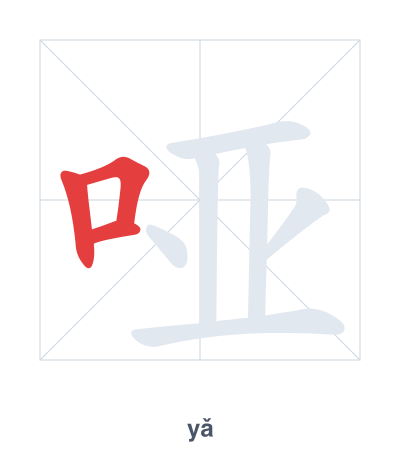
Open Hanzi Writer to see the animated stroke order and practice writing 哑 with real-time feedback.
The character 哑 (yǎ) is written with 9 strokes. Follow the standard Chinese stroke order: top to bottom, left to right, outside before inside. The radical 口 is one of its key components.
Practice the correct stroke order with the Hanzi Writer app to see animated stroke-by-stroke guidance with real-time feedback.
哑 means Mute / Hoarse.
As an HSK Level 7 character, 哑 is an intermediate-level character.
哑 is a phono-semantic compound: the mouth radical (口) represents speech, while the phonetic component 亚 (yǎ, meaning 'inferior' or 'secondary') suggests impaired function, together conveying a mouth that produces only weak or no sound—hence 'mute' or 'hoarse'.
💡 Memory Tip: A person opens their mouth (口) to speak but can only force out a faint 'ya' (亚) because they are hoarse or mute.
他是个哑巴。
tā shì gè yǎ ba
He is a mute.
他的嗓子沙哑了。
tā de sǎng zi shā yǎ le
His voice is hoarse.
我在举哑铃。
wǒ zài jǔ yǎ líng
I am lifting dumbbells.
Open Hanzi Writer to see the animated stroke order and practice writing 哑 with real-time feedback.
✨ Animated stroke order · Handwriting recognition · HSK-graded practice · Free to use
The character 哑 is composed of the radical 口 (mouth) on the left and 亚 (yà) on the right. The 口 component directly relates to the mouth and voice, while 亚 provides the sound and suggests the idea of being secondary or impaired, together meaning mute or hoarse.