悬 (xuán) means "hang" in Chinese. It has 11 strokes with the radical 心, and is HSK Level 6.
Rated 4.2/5 in difficulty (advanced).
Harder than 60% of HSK Level 6 characters.
Appears in 3+ common words including 悬挂 (xuán guà), 悬念 (xuán niàn), 悬殊 (xuán shū).
Due to its 11 strokes, Hanzi Writer's error detection shows 悬 requires focused practice — most learners need 10+ attempts for consistent accuracy.
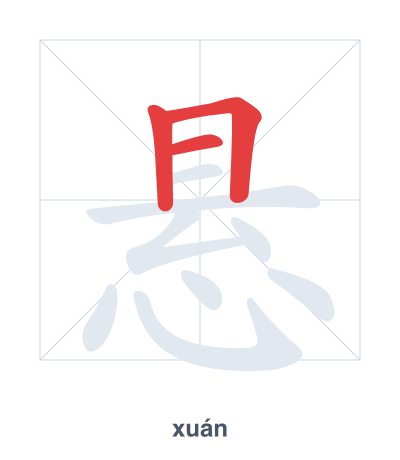
Open Hanzi Writer to see the animated stroke order and practice writing 悬 with real-time feedback.
The character 悬 (xuán) is written with 11 strokes. Follow the standard Chinese stroke order: top to bottom, left to right, outside before inside. The radical 心 is one of its key components.
Practice the correct stroke order with the Hanzi Writer app to see animated stroke-by-stroke guidance with real-time feedback.
悬 means hang.
As an HSK Level 6 character, 悬 is an intermediate-level character.
悬 combines 县 (originally a pictograph of a severed head hanging upside down) with 心 (heart). The visual shows something suspended, with the heart added to convey the anxious feeling of being 'hung up' or suspended in uncertainty.
💡 Memory Tip: Picture a heart (心) dangling from a hook (the top part 县 looks like a hook with a string) — it's hanging in suspense.
墙上悬挂着国旗。
qiáng shàng xuán guà zhe guó qí
The national flag is hanging on the wall.
电影留下了悬念。
diàn yǐng liú xià le xuán niàn
The movie left a cliffhanger.
两队实力悬殊。
liǎng duì shí lì xuán shū
There is a huge disparity in strength between the two teams.
Open Hanzi Writer to see the animated stroke order and practice writing 悬 with real-time feedback.
✨ Animated stroke order · Handwriting recognition · HSK-graded practice · Free to use
悬 is made of two parts: the top part 县 and the bottom part 心 (heart). The top originally related to hanging, and the heart radical adds an emotional sense, so the character suggests something hanging or suspended, often with worry or suspense.