念 (niàn) means "to read aloud; to miss; thought" in Chinese. It has 8 strokes with the radical 心, and is HSK Level 3.
Rated 3.7/5 in difficulty (challenging).
Harder than 49% of HSK Level 3 characters.
Appears in 3+ common words including 想念 (xiǎng niàn), 念书 (niàn shū), 观念 (guān niàn).
Due to its 8 strokes, Hanzi Writer's error detection shows 念 requires focused practice — most learners need 10+ attempts for consistent accuracy.
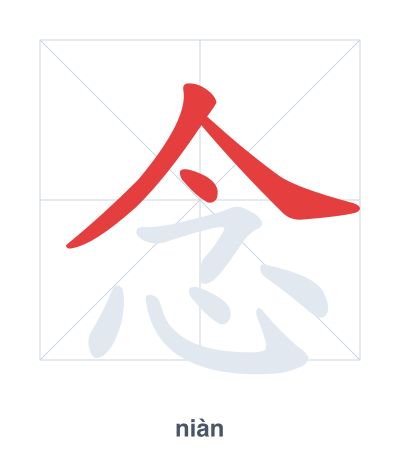
Open Hanzi Writer to see the animated stroke order and practice writing 念 with real-time feedback.
The character 念 (niàn) is written with 8 strokes. Follow the standard Chinese stroke order: top to bottom, left to right, outside before inside. The radical 心 is one of its key components.
Practice the correct stroke order with the Hanzi Writer app to see animated stroke-by-stroke guidance with real-time feedback.
念 means to read aloud; to miss; thought.
As an HSK Level 3 character, 念 is an intermediate-level character.
念 combines 今 (present) and 心 (heart), visually meaning 'what is in the heart at this moment' — thus capturing the ideas of thinking, missing, or reciting something from memory.
💡 Memory Tip: Imagine your 'now' (今) is a heavy weight on your heart (心) because you can't stop missing someone — that's 念.
我很想念我的家人。
wǒ hěn xiǎng niàn wǒ de jiā rén
I miss my family very much.
他正在房间里念书。
tā zhèng zài fáng jiān lǐ niàn shū
He is studying in the room.
大家的观念在改变。
dà jiā de guān niàn zài gǎi biàn
Everyone's ideas are changing.
Open Hanzi Writer to see the animated stroke order and practice writing 念 with real-time feedback.
✨ Animated stroke order · Handwriting recognition · HSK-graded practice · Free to use
念 is made of 今 (now) on top and 心 (heart) on the bottom. The heart component suggests feelings or thoughts, so together they mean "thinking of now" – which connects to "to miss" or "to think". This structure explains why 念 can mean both reading aloud (using your mind) and missing someone (using your heart).