耻 (chǐ) means "shame; disgrace; humiliation" in Chinese. It has 10 strokes with the radical 耳, and is HSK Level 7.
Rated 4.2/5 in difficulty (advanced).
Harder than 82% of HSK Level 7 characters.
Appears in 3+ common words including 羞耻 (xiū chǐ), 无耻 (wú chǐ), 耻辱 (chǐ rǔ).
Due to its 10 strokes, Hanzi Writer's error detection shows 耻 requires focused practice — most learners need 10+ attempts for consistent accuracy.
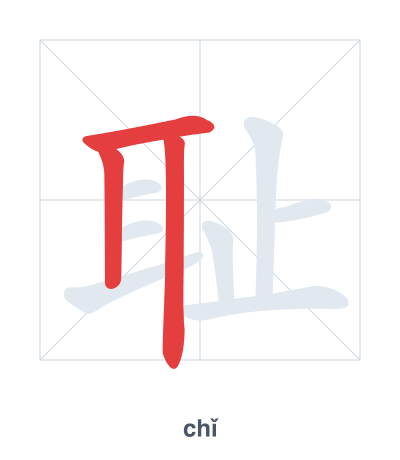
Open Hanzi Writer to see the animated stroke order and practice writing 耻 with real-time feedback.
The character 耻 (chǐ) is written with 10 strokes. Follow the standard Chinese stroke order: top to bottom, left to right, outside before inside. The radical 耳 is one of its key components.
Practice the correct stroke order with the Hanzi Writer app to see animated stroke-by-stroke guidance with real-time feedback.
耻 means shame; disgrace; humiliation.
As an HSK Level 7 character, 耻 is an intermediate-level character.
The character 耻 (chǐ) originally derived from 恥, combining the radical 心 (heart) to indicate an internal feeling, and 耳 (ear) suggesting that shame makes one's ears red. The modern simplified form 耻 uses 耳 (ear) with the phonetic component 止 (stop), hinting at turning away or stopping one's ears in disgrace.
💡 Memory Tip: Imagine an ear (耳) that stops (止) listening because it's too ashamed to hear the truth.
他感到非常羞耻。
tā gǎn dào fēi cháng xiū chǐ
He feels very ashamed.
这种行为太无耻了。
zhè zhǒng xíng wéi tài wú chǐ le
This behavior is too shameless.
这是他一生的耻辱。
zhè shì tā yī shēng de chǐ rǔ
This is the shame of his life.
Open Hanzi Writer to see the animated stroke order and practice writing 耻 with real-time feedback.
✨ Animated stroke order · Handwriting recognition · HSK-graded practice · Free to use
The character 耻 combines the radical 耳 (ear) on the left with 止 (stop) on the right. This structure suggests the idea of feeling so ashamed that you want to "stop" or cover your ears, connecting the ear to the emotion of shame.