隙 (xì) means "gap; crack; opportunity" in Chinese. It has 12 strokes with the radical 阝, and is HSK Level 7.
Rated 3.9/5 in difficulty (challenging).
Harder than 37% of HSK Level 7 characters.
Appears in 3+ common words including 缝隙 (fèng xì), 空隙 (kòng xì), 间隙 (jiàn xì).
Due to its 12 strokes, Hanzi Writer's error detection shows 隙 requires focused practice — most learners need 10+ attempts for consistent accuracy.
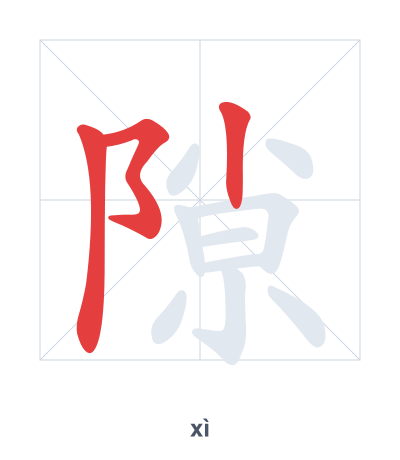
Open Hanzi Writer to see the animated stroke order and practice writing 隙 with real-time feedback.
The character 隙 (xì) is written with 12 strokes. Follow the standard Chinese stroke order: top to bottom, left to right, outside before inside. The radical 阝 is one of its key components.
Practice the correct stroke order with the Hanzi Writer app to see animated stroke-by-stroke guidance with real-time feedback.
隙 means gap; crack; opportunity.
As an HSK Level 7 character, 隙 is an intermediate-level character.
The left radical 阝 (from 阜, meaning mound or hill) indicates a cliff or elevated terrain. The right component 巢 depicts a bird's nest with twigs, representing a hollow crevice. Together, they signify a natural crack or gap in a cliff where birds might nest, hence 'gap' or 'crack' and metaphorically 'opportunity'.
💡 Memory Tip: Picture a small gap (隙) in a hillside (阝) where a bird's nest (巢) is tucked inside, creating the perfect opportunity for a peeking view.
墙上有一道小缝隙。
qiáng shàng yǒu yī dào xiǎo fèng xì
There is a small crack in the wall.
找个空隙休息一下吧。
zhǎo gè kòng xì xiū xī yī xià ba
Find a moment to take a break.
牙齿之间有间隙。
yá chǐ zhī jiān yǒu jiàn xì
There are gaps between the teeth.
Open Hanzi Writer to see the animated stroke order and practice writing 隙 with real-time feedback.
✨ Animated stroke order · Handwriting recognition · HSK-graded practice · Free to use
The character 隙 combines the radical 阝 (meaning "hill") on the left and the component 隙 (which itself contains 小 and 白) on the right. The left radical suggests a physical opening in nature, while the right part may hint at a small space or crack, together forming the idea of a gap or crevice.