郭 (guō) means "Guo (a surname)" in Chinese. It has 10 strokes with the radical 阝.
Rated 3.9/5 in difficulty (challenging).
Appears in 3+ common words including 郭先生 (guō xiān shēng), 姓郭 (xìng guō), 城郭 (chéng guō).
Due to its 10 strokes, Hanzi Writer's error detection shows 郭 requires focused practice — most learners need 10+ attempts for consistent accuracy.
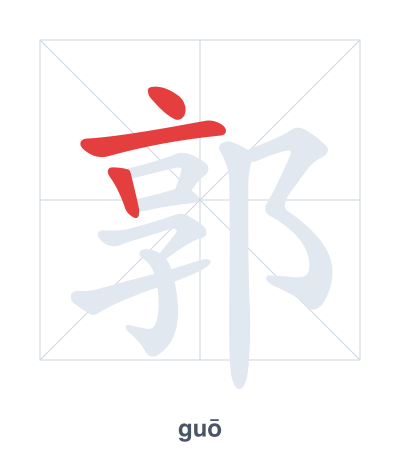
Open Hanzi Writer to see the animated stroke order and practice writing 郭 with real-time feedback.
The character 郭 (guō) is written with 10 strokes. Follow the standard Chinese stroke order: top to bottom, left to right, outside before inside. The radical 阝 is one of its key components.
Practice the correct stroke order with the Hanzi Writer app to see animated stroke-by-stroke guidance with real-time feedback.
郭 means Guo (a surname).
郭 is a compound character: the left radical 阝 (an abbreviation of 邑 'city') indicates a walled settlement, while the right part 享 originally depicted a tall watchtower or sacrificial hall. Together, they represent an outer city wall or a fortified enclosure, which later became a common surname in ancient China.
💡 Memory Tip: Picture a grand city wall (阝) with a towering watchtower (享) where the Guo family stands guard—a fortress of memory.
郭先生是我的老师。
guō xiān shēng shì wǒ de lǎo shī
Mr. Guo is my teacher.
我最好的朋友姓郭。
wǒ zuì hǎo de péng yǒu xìng guō
My best friend's surname is Guo.
这里的城郭很古老。
zhè lǐ de chéng guō hěn gǔ lǎo
The city walls here are very ancient.
Open Hanzi Writer to see the animated stroke order and practice writing 郭 with real-time feedback.
✨ Animated stroke order · Handwriting recognition · HSK-graded practice · Free to use
The character 郭 has two parts: the left radical 阝 (meaning 'city' or 'mound') and the right side 享 (which gives the sound guō). The radical 阝 connects 郭 to the idea of city walls (城郭), though in modern use it is mainly a surname.