缝 (féng/fèng) means "to sew; seam; crack" in Chinese. It has 13 strokes with the radical 纟, and is HSK Level 7.
Rated 4.2/5 in difficulty (advanced).
Harder than 81% of HSK Level 7 characters.
Appears in 4+ common words including 缝隙 (fèng xì), 裂缝 (liè fèng), 缝补 (féng bǔ).
Due to its 13 strokes, Hanzi Writer's error detection shows 缝 requires focused practice — most learners need 10+ attempts for consistent accuracy.
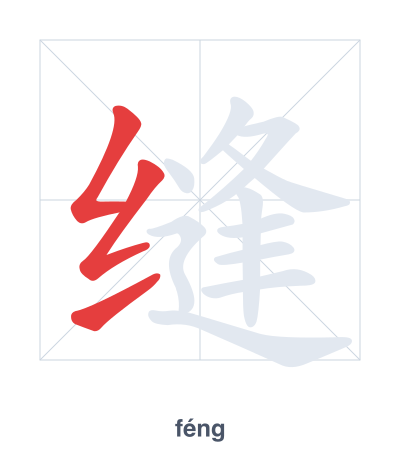
Open Hanzi Writer to see the animated stroke order and practice writing 缝 with real-time feedback.
The character 缝 (féng/fèng) is written with 13 strokes. Follow the standard Chinese stroke order: top to bottom, left to right, outside before inside. The radical 纟 is one of its key components.
Practice the correct stroke order with the Hanzi Writer app to see animated stroke-by-stroke guidance with real-time feedback.
缝 means to sew; seam; crack.
This is a polyphonic character with readings: féng, fèng.
As an HSK Level 7 character, 缝 is an intermediate-level character.
The character combines the 'silk' radical (纟) with 逢 (fèng, 'to meet'), using silk thread to join or meet separate pieces of fabric. This visually represents sewing a seam or crack, where the thread brings two edges together.
💡 Memory Tip: Picture a seamstress using red silk thread (纟) to stitch a glowing 'feng' crystal into a crack on a torn cloth, sealing it perfectly.
阳光透过墙上的缝隙照了进来。
yáng guāng tòu guò qiáng shàng de fèng xì zhào le jìn lái
Sunlight shone in through the cracks in the wall.
地震后,路面出现了巨大的裂缝。
dì zhèn hòu lù miàn chū xiàn le jù dà de liè fèng
After the earthquake, huge cracks appeared on the road surface.
妈妈正在灯下为我缝补旧衣服。
mā mā zhèng zài dēng xià wèi wǒ féng bǔ jiù yī fú
Mom is mending old clothes for me under the lamp.
缝纫机发出了节奏明快的响声。
féng rèn jī fā chū le jié zòu míng kuài de xiǎng shēng
The sewing machine made a rhythmic and brisk sound.
Open Hanzi Writer to see the animated stroke order and practice writing 缝 with real-time feedback.
✨ Animated stroke order · Handwriting recognition · HSK-graded practice · Free to use
The left component 纟 (silk radical) indicates the meaning relates to thread or fabric. The right part 逢 (féng) provides the pronunciation and originally meant 'to meet,' so together they suggest thread meeting or joining fabric — the action of sewing.