郫 (pí) means "Pi (a place name)" in Chinese. It has 10 strokes with the radical 阝.
Rated 3.9/5 in difficulty (challenging).
Appears in 3+ common words including 郫县 (pí xiàn), 郫县豆瓣 (pí xiàn dòu bàn), 郫都区 (pí dōu qū).
Due to its 10 strokes, Hanzi Writer's error detection shows 郫 requires focused practice — most learners need 10+ attempts for consistent accuracy.
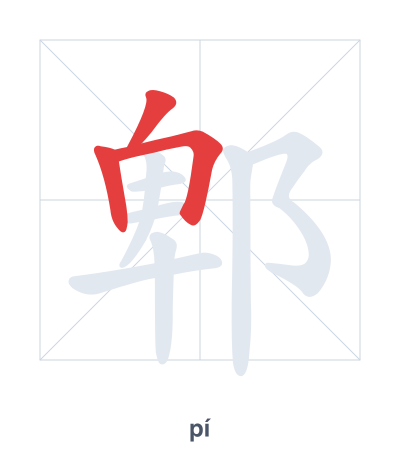
Open Hanzi Writer to see the animated stroke order and practice writing 郫 with real-time feedback.
The character 郫 (pí) is written with 10 strokes. Follow the standard Chinese stroke order: top to bottom, left to right, outside before inside. The radical 阝 is one of its key components.
Practice the correct stroke order with the Hanzi Writer app to see animated stroke-by-stroke guidance with real-time feedback.
郫 means Pi (a place name).
郫 is a compound character with the radical 阝 (邑, meaning 'city') and the phonetic component 卑 (bēi, meaning 'low' or 'humble'). It names an ancient city in Sichuan, likely referring to its location in low-lying terrain.
💡 Memory Tip: Picture a city (阝) sitting in a low basin (卑), a humble place called Pi.
郫县在四川省。
pí xiàn zài sì chuān shěng
Pi County is in Sichuan Province.
郫县豆瓣很有名。
pí xiàn dòu bàn hěn yǒu míng
Pixian bean paste is very famous.
他住在郫都区。
tā zhù zài pí dōu qū
He lives in Pidu District.
Open Hanzi Writer to see the animated stroke order and practice writing 郫 with real-time feedback.
✨ Animated stroke order · Handwriting recognition · HSK-graded practice · Free to use
The character 郫 is formed with the radical 阝 (left ear) on the left, which originally meant a mound or a place, and 卑 (bēi) on the right as a phonetic component. Together, 郫 is used as a place name, specifically referring to areas like Pi County in Sichuan, with no direct meaning from its parts.