稳 (wěn) means "stable; steady" in Chinese. It has 14 strokes with the radical 禾, and is HSK Level 4.
Rated 4.2/5 in difficulty (advanced).
Harder than 83% of HSK Level 4 characters.
Appears in 3+ common words including 稳定 (wěn dìng), 稳重 (wěn zhòng), 站稳 (zhàn wěn).
Due to its 14 strokes, Hanzi Writer's error detection shows 稳 requires focused practice — most learners need 10+ attempts for consistent accuracy.
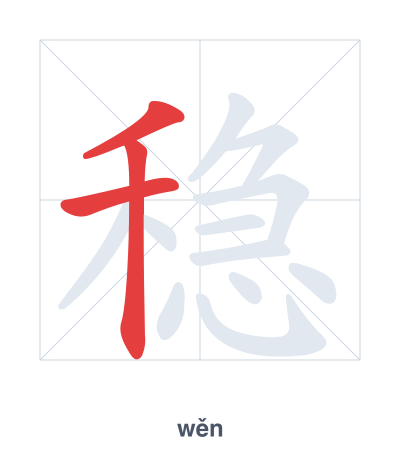
Open Hanzi Writer to see the animated stroke order and practice writing 稳 with real-time feedback.
The character 稳 (wěn) is written with 14 strokes. Follow the standard Chinese stroke order: top to bottom, left to right, outside before inside. The radical 禾 is one of its key components.
Practice the correct stroke order with the Hanzi Writer app to see animated stroke-by-stroke guidance with real-time feedback.
稳 means stable; steady.
As an HSK Level 4 character, 稳 is an intermediate-level character.
稳 combines 禾 (grain) with 㥯 (cautious, to hide), originally depicting grain stored carefully to remain steady and secure. The right component in the simplified form resembles 急 (urgent), but the core idea is safe, stable storage.
💡 Memory Tip: Picture grain (禾) stacked perfectly steady even as an urgent (急) wind howls—because the farmer packed it with care, nothing falls.
他的工作很稳定。
tā de gōng zuò hěn wěn dìng
His job is very stable.
他是一个稳重的人。
tā shì yí gè wěn zhòng de rén
He is a steady and reliable person.
请在车上站稳。
qǐng zài chē shàng zhàn wěn
Please stand firmly while on the vehicle.
Open Hanzi Writer to see the animated stroke order and practice writing 稳 with real-time feedback.
✨ Animated stroke order · Handwriting recognition · HSK-graded practice · Free to use
稳 is made of two parts: the left radical 禾 (grain) and the right part 急 (urgent). The grain radical suggests agriculture and food, which are essential for a stable life, while 急 implies that stability is needed most during urgent times. Together, the components convey the idea of remaining steady when pressure or urgency arises.