秃 (tū) means "bald; bare" in Chinese. It has 7 strokes with the radical 禾, and is HSK Level 7.
Rated 3.5/5 in difficulty (challenging).
Harder than 20% of HSK Level 7 characters.
Appears in 3+ common words including 秃顶 (tū dǐng), 秃头 (tū tóu), 秃笔 (tū bǐ).
Due to its 7 strokes, Hanzi Writer's error detection shows 秃 requires focused practice — most learners need 10+ attempts for consistent accuracy.
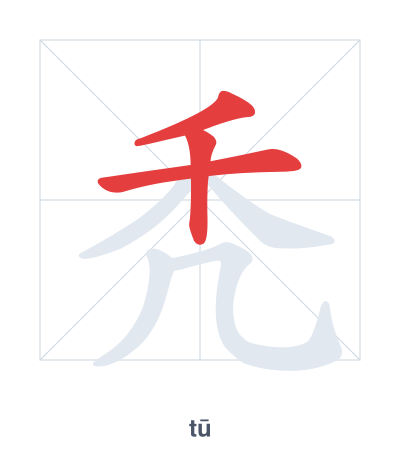
Open Hanzi Writer to see the animated stroke order and practice writing 秃 with real-time feedback.
The character 秃 (tū) is written with 7 strokes. Follow the standard Chinese stroke order: top to bottom, left to right, outside before inside. The radical 禾 is one of its key components.
Practice the correct stroke order with the Hanzi Writer app to see animated stroke-by-stroke guidance with real-time feedback.
秃 means bald; bare.
As an HSK Level 7 character, 秃 is an intermediate-level character.
The character 秃 (tū) originally depicted a person with a bald head. Its modern form combines 禾 (grain, symbolizing the top) and 几 (a stool, suggesting an empty base), together conveying a bare or hairless surface.
💡 Memory Tip: Picture a grain stalk (禾) on a stool (几) with all its seeds plucked off, leaving it completely bare and bald.
那个男人秃顶了。
nà ge nán rén tū dǐng le
That man is balding.
他剪了一个秃头。
tā jiǎn le yí gè tū tóu
He got a buzz cut.
这是一支秃笔。
zhè shì yī zhī tū bǐ
This is a worn-out writing brush.
Open Hanzi Writer to see the animated stroke order and practice writing 秃 with real-time feedback.
✨ Animated stroke order · Handwriting recognition · HSK-graded practice · Free to use
秃 is made of two parts: the top is 禾 (the grain radical) and the bottom is 几 (a table-like shape). Although the grain radical does not directly suggest baldness, the overall shape can be imagined as a head with no hair, giving the meaning "bald" or "bare".