秆 (gǎn) means "Stalk; stem." in Chinese. It has 8 strokes with the radical 禾.
Rated 3.7/5 in difficulty (challenging).
Appears in 3+ common words including 秸秆 (jiē gǎn), 麦秆 (mài gǎn), 秆子 (gǎn zi).
Due to its 8 strokes, Hanzi Writer's error detection shows 秆 requires focused practice — most learners need 10+ attempts for consistent accuracy.
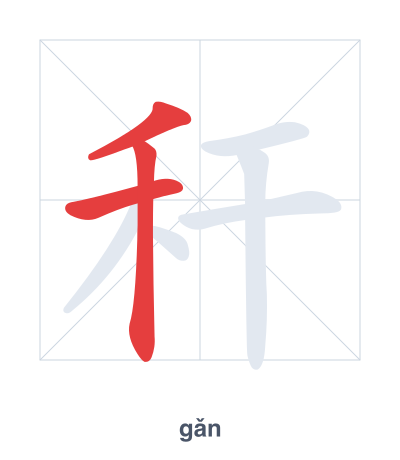
Open Hanzi Writer to see the animated stroke order and practice writing 秆 with real-time feedback.
The character 秆 (gǎn) is written with 8 strokes. Follow the standard Chinese stroke order: top to bottom, left to right, outside before inside. The radical 禾 is one of its key components.
Practice the correct stroke order with the Hanzi Writer app to see animated stroke-by-stroke guidance with real-time feedback.
秆 means Stalk; stem..
秆 combines the radical 禾 (grain) with 干, which acts as a phonetic component and also suggests something dry and stiff. The character depicts the dry, upright stem or stalk of a grain plant.
💡 Memory Tip: Picture a grain plant (禾) with a strong, straight stem standing like a dry pole (干).
农民在田里处理秸秆。
nóng mín zài tián lǐ chǔ lǐ jiē gǎn
Farmers are processing stalks in the field.
麦秆可以用来编帽子。
mài gǎn kě yǐ yòng lái biān mào zi
Wheat stalks can be used to weave hats.
这棵植物的秆子很细。
zhè kē zhí wù de gǎn zi hěn xì
The stalk of this plant is very thin.
Open Hanzi Writer to see the animated stroke order and practice writing 秆 with real-time feedback.
✨ Animated stroke order · Handwriting recognition · HSK-graded practice · Free to use
秆 is made of two parts: the left radical 禾 (grain/plant) and the right part 干 (gān, meaning dry). The 禾 shows that the character is related to plants, while 干 suggests that stalks are often dry or stiff. Together they form the meaning 'stalk' or 'stem' of a grain plant.