剃 (tì) means "to shave" in Chinese. It has 9 strokes with the radical 刂, and is HSK Level 7.
Rated 3.7/5 in difficulty (challenging).
Harder than 23% of HSK Level 7 characters.
Appears in 3+ common words including 剃头 (tì tóu), 剃须刀 (tì xū dāo), 剃光 (tì guāng).
Due to its 9 strokes, Hanzi Writer's error detection shows 剃 requires focused practice — most learners need 10+ attempts for consistent accuracy.
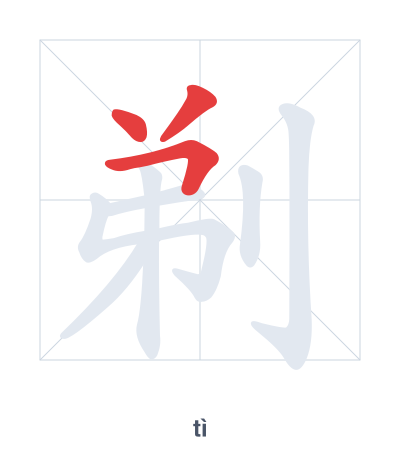
Open Hanzi Writer to see the animated stroke order and practice writing 剃 with real-time feedback.
The character 剃 (tì) is written with 9 strokes. Follow the standard Chinese stroke order: top to bottom, left to right, outside before inside. The radical 刂 is one of its key components.
Practice the correct stroke order with the Hanzi Writer app to see animated stroke-by-stroke guidance with real-time feedback.
剃 means to shave.
As an HSK Level 7 character, 剃 is an intermediate-level character.
剃 is a phono-semantic compound: the left side 弟 (younger brother) hints at the pronunciation (tì), while the right side 刂 (knife) represents the act of shaving or cutting hair. The character originally meant to shave the head or beard.
💡 Memory Tip: Picture your younger brother (弟) nervously holding a knife (刂) to shave his own head.
爷爷去理发店剃头。
yé yé qù lǐ fà diàn tì tóu
Grandpa went to the barbershop to get a haircut.
我买了一个新剃须刀。
wǒ mǎi le yí gè xīn tì xū dāo
I bought a new razor.
他把胡子剃光了。
tā bǎ hú zi tì guāng le
He shaved off his beard.
Open Hanzi Writer to see the animated stroke order and practice writing 剃 with real-time feedback.
✨ Animated stroke order · Handwriting recognition · HSK-graded practice · Free to use
剃 combines the left side 弟 (dì, meaning 'younger brother,' used here for sound) and the right side 刂 (knife radical). The knife radical indicates the action of cutting or shaving, while 弟 provides the pronunciation. Together, they form the character for shaving hair or beard.