刎 (wěn) means "to cut one's throat" in Chinese. It has 6 strokes with the radical 刂.
Rated 2.9/5 in difficulty (moderate).
Appears in 3+ common words including 自刎 (zì wěn), 刎颈 (wěn jǐng), 刎颈之交 (wěn jǐng zhī jiāo).
Hanzi Writer's stroke validation shows learners typically need 5-8 attempts to write 刎 with correct proportion and order.
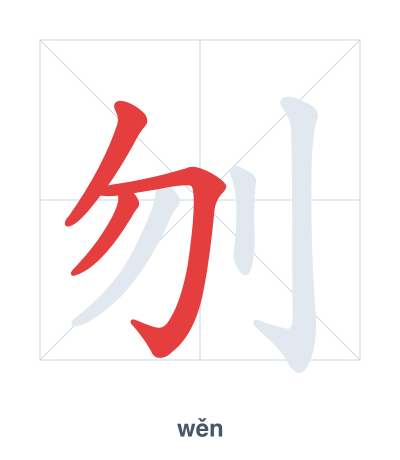
Open Hanzi Writer to see the animated stroke order and practice writing 刎 with real-time feedback.
The character 刎 (wěn) is written with 6 strokes. Follow the standard Chinese stroke order: top to bottom, left to right, outside before inside. The radical 刂 is one of its key components.
Practice the correct stroke order with the Hanzi Writer app to see animated stroke-by-stroke guidance with real-time feedback.
刎 means to cut one's throat.
The character 刎 (wěn) combines the knife radical 刂, which indicates a cutting action, with the phonetic component 勿 (wù, meaning 'do not'), which here contributes the sound. Together, they depict the act of slitting the throat with a blade.
💡 Memory Tip: Imagine a knife (刂) slicing through the neck of a person whose head is tilted to the side, forming the shape 勿, as they whisper '勿' (don't) just before the fatal cut.
他选择自刎而死。
tā xuǎn zé zì wěn ér sǐ
He chose to commit suicide by slitting his throat.
他们是刎颈之交。
tā men shì wěn jǐng zhī jiāo
They are friends who would die for each other.
这种友谊很难得。
zhè zhǒng yǒu yì hěn nán dé
This kind of friendship is rare and precious.
Open Hanzi Writer to see the animated stroke order and practice writing 刎 with real-time feedback.
✨ Animated stroke order · Handwriting recognition · HSK-graded practice · Free to use
刎 is a left-right character: the left part is 勿 (wù, meaning 'do not') and the right part is 刂 (knife radical). The knife radical gives the meaning of cutting, while 勿 provides pronunciation and hints at the fatal action. Together, they suggest using a knife to end something, specifically cutting one's throat.