须 (xū) means "must; beard; mustache" in Chinese. It has 9 strokes with the radical 彡, and is HSK Level 2.
Rated 3.5/5 in difficulty (challenging).
Harder than 70% of HSK Level 2 characters.
Appears in 3+ common words including 必须 (bì xū), 须知 (xū zhī), 胡须 (hú xū).
Due to its 9 strokes, Hanzi Writer's error detection shows 须 requires focused practice — most learners need 10+ attempts for consistent accuracy.
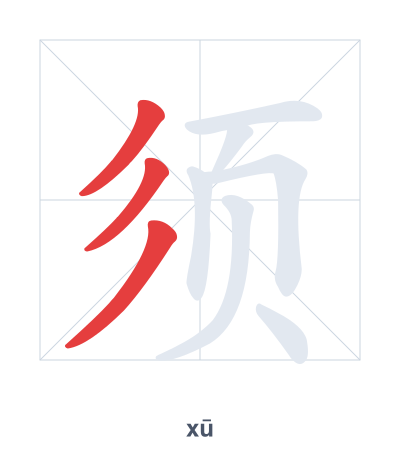
Open Hanzi Writer to see the animated stroke order and practice writing 须 with real-time feedback.
The character 须 (xū) is written with 9 strokes. Follow the standard Chinese stroke order: top to bottom, left to right, outside before inside. The radical 彡 is one of its key components.
Practice the correct stroke order with the Hanzi Writer app to see animated stroke-by-stroke guidance with real-time feedback.
须 means must; beard; mustache.
As an HSK Level 2 character, 须 is among the first characters beginners learn.
In the ancient form, 须 combines 彡 (bristle/hair) with 頁 (head), depicting hair on the face or chin, hence 'beard'. Over time, the meaning extended to 'must' as a grammatical necessity, possibly from the idea of what is required (like the need for a beard?).
💡 Memory Tip: Imagine a head (页) with three long hairs (彡) sprouting from the chin, forming a beard you must trim.
你必须准时参加会议。
nǐ bì xū zhǔn shí cān jiā huì yì
You must attend the meeting on time.
请阅读考试须知。
qǐng yuè dú kǎo shì xū zhī
Please read the exam instructions.
他的胡须很长。
tā de hú xū hěn zhǎng
His beard is very long.
Open Hanzi Writer to see the animated stroke order and practice writing 须 with real-time feedback.
✨ Animated stroke order · Handwriting recognition · HSK-graded practice · Free to use
The left component 彡 (three strokes) originally represents hair or bristles, and the right component 页 means 'head'. Together, they depict hair on the face, giving the original meaning 'beard'. Later, the character was borrowed to mean 'must' due to sound similarity.