Hanzi Writer

How to Write 刨 (bào/páo) — Meaning “To dig or plane.”

bào/páo HSK Level 7 7 strokes Radical: 刂

刨 (bào/páo) means "To dig or plane." in Chinese. It has 7 strokes with the radical 刂, and is HSK Level 7.

Rated 3.2/5 in difficulty (challenging).

Harder than 9% of HSK Level 7 characters.

Appears in 4+ common words including 刨坑 (páo kēng), 刨根问底 (páo gēn wèn dǐ), 刨子 (bào zǐ).

Due to its 7 strokes, Hanzi Writer's error detection shows 刨 requires focused practice — most learners need 10+ attempts for consistent accuracy.
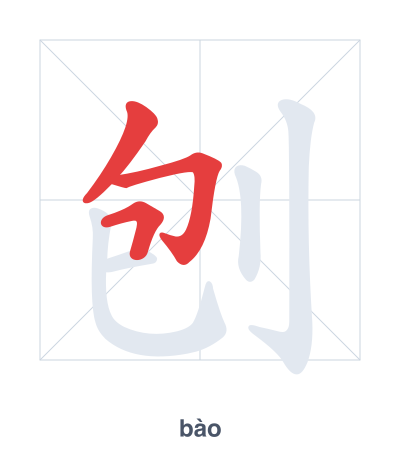
Stroke order practice for 刨 - bào/páo

Practice Writing 刨 (bào/páo)

Open Hanzi Writer to see the animated stroke order and practice writing 刨 with real-time feedback.

The character (bào/páo) is written with 7 strokes. Follow the standard Chinese stroke order: top to bottom, left to right, outside before inside. The radical is one of its key components.

Practice the correct stroke order with the Hanzi Writer app to see animated stroke-by-stroke guidance with real-time feedback.

means To dig or plane..

This is a polyphonic character with readings: bào, páo.

As an HSK Level 7 character, is an intermediate-level character.

Character
Pinyinbào / páo (bao/pao)
MeaningTo dig or plane.
Strokes7
Radical
HSK Level7
Difficulty3.2/5

The left component 包 (bāo) originally depicted a fetus in a womb, meaning to wrap or enclose. The right radical 刂 (knife) adds the action of cutting. Together, they suggest using a blade to cut or dig material out of a surface, like a plane shaving wood or a tool excavating earth.

💡 Memory Tip: Imagine a wrapped package (包) being sliced open with a knife (刂) to dig out the contents inside.

páo kēng
To dig a hole.
páo gēn wèn dǐ
To get to the bottom of things or to inquire deeply
bào zǐ
Plane (woodworking tool)
bào chuáng
Planing machine

园丁正在花园里刨坑,准备栽种树苗。

yuán dīng zhèng zài huā yuán lǐ páo kēng zhǔn bèi zāi zhòng shù miáo

The gardener is digging holes in the garden, preparing to plant saplings.

他对什么都好奇,总是喜欢刨根问底。

tā duì shén me dōu hào qí zǒng shì xǐ huān páo gēn wèn dǐ

He is curious about everything and always likes to get to the bottom of things.

木工熟练地使用刨子把木板推得平整光滑。

mù gōng shú liàn dì shǐ yòng bào zǐ bǎ mù bǎn tuī dé píng zhěng guāng huá

The carpenter skillfully used a plane to make the wooden board smooth and level.

工厂里这台老式刨床依然在正常运转。

gōng chǎng lǐ zhè tái lǎo shì bào chuáng yī rán zài zhèng cháng yùn zhuàn

This old-fashioned planer in the factory is still operating normally.

Character Pinyin Strokes Radical
(current) bào / páo 7
kān 5
wěn 6
xíng 6
Stroke order practice for 刨 - bào/páo

Practice Writing 刨 (bào/páo)

Open Hanzi Writer to see the animated stroke order and practice writing 刨 with real-time feedback.

✨ Animated stroke order · Handwriting recognition · HSK-graded practice · Free to use

Frequently Asked Questions about 刨

The character 刨 combines 包 (bāo, meaning "to wrap") on the left and 刂 (dāo, meaning "knife") on the right. The knife radical indicates a cutting action, while 包 suggests the idea of removing or separating material — together they represent using a blade to dig or plane a surface flat.

More HSK Level 7 Characters

Characters with Radical 刂

Other 7-Stroke Characters