刈 (yì) means "to mow" in Chinese. It has 4 strokes with the radical 刂.
Rated 2.4/5 in difficulty (moderate).
Appears in 3+ common words including 刈草 (yì cǎo), 刈除 (yì chú), 刈麦 (yì mài).
Hanzi Writer's stroke validation shows learners typically need 5-8 attempts to write 刈 with correct proportion and order.
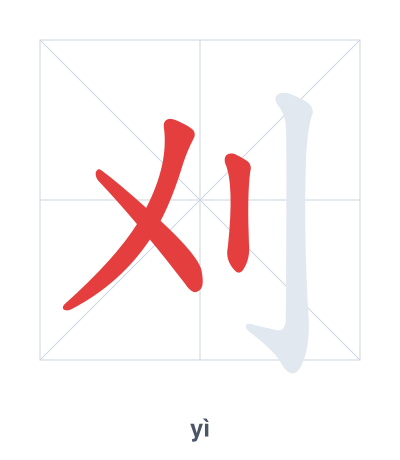
Open Hanzi Writer to see the animated stroke order and practice writing 刈 with real-time feedback.
The character 刈 (yì) is written with 4 strokes. Follow the standard Chinese stroke order: top to bottom, left to right, outside before inside. The radical 刂 is one of its key components.
Practice the correct stroke order with the Hanzi Writer app to see animated stroke-by-stroke guidance with real-time feedback.
刈 means to mow.
刈 is a compound character combining 乂 (yì), an ancient pictograph of a curved blade or scythe, with the radical 刂 (knife) on the right, reinforcing the idea of cutting. Together, they depict the action of mowing or reaping grass or grain with a bladed tool.
💡 Memory Tip: Imagine a curved scythe (乂) and a sharp knife (刂) working together to mow down tall grass in one swift motion.
农民在田里刈草。
nóng mín zài tián lǐ yì cǎo
Farmers are mowing grass in the field.
杂草需要刈除。
zá cǎo xū yào yì chú
The weeds need to be mown.
他在农场刈麦子。
tā zài nóng chǎng yì mài zi
He is reaping wheat on the farm.
Open Hanzi Writer to see the animated stroke order and practice writing 刈 with real-time feedback.
✨ Animated stroke order · Handwriting recognition · HSK-graded practice · Free to use
The character 刈 is formed by the knife radical 刂 on the right, and the left component 乂 (yì). The left part originally depicted a cutting tool, and together with the knife radical, the character conveys the action of cutting or mowing, especially grass or crops.