刚 (gāng) means "just / firm / strong" in Chinese. It has 6 strokes with the radical 刂, and is HSK Level 2.
Rated 2.4/5 in difficulty (moderate).
Harder than 16% of HSK Level 2 characters.
Appears in 3+ common words including 刚才 (gāng cái), 刚刚 (gāng gāng), 刚好 (gāng hǎo).
Hanzi Writer's stroke validation shows learners typically need 5-8 attempts to write 刚 with correct proportion and order.
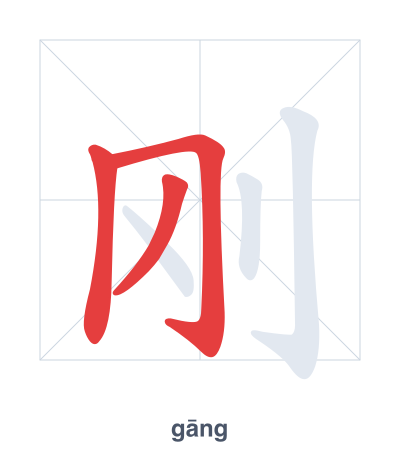
Open Hanzi Writer to see the animated stroke order and practice writing 刚 with real-time feedback.
The character 刚 (gāng) is written with 6 strokes. Follow the standard Chinese stroke order: top to bottom, left to right, outside before inside. The radical 刂 is one of its key components.
Practice the correct stroke order with the Hanzi Writer app to see animated stroke-by-stroke guidance with real-time feedback.
刚 means just / firm / strong.
As an HSK Level 2 character, 刚 is among the first characters beginners learn.
The character 刚 is a phono-semantic compound. The left side 冈 (gāng, meaning 'ridge' or 'hill') gives the pronunciation, while the right side 刂 (dāo, 'knife') indicates its original meaning related to cutting with a strong, firm blade. Over time, the meaning expanded to 'firm', 'strong', and 'just'.
💡 Memory Tip: Picture a knife (刂) striking a steel mountain (冈) and staying perfectly unbroken — that's firmness and justice.
刚才谁来过?
gāng cái shuí lái guò
Who was here just now?
电影刚刚开始。
diàn yǐng gāng gāng kāi shǐ
The movie has just started.
这双鞋刚好合脚。
zhè shuāng xié gāng hǎo hé jiǎo
This pair of shoes fits perfectly.
Open Hanzi Writer to see the animated stroke order and practice writing 刚 with real-time feedback.
✨ Animated stroke order · Handwriting recognition · HSK-graded practice · Free to use
刚 is made of two parts: the left side 冈 (gāng, meaning 'hill' or 'ridge') gives the pronunciation, and the right side 刂 (the knife radical) suggests cutting or sharpness. Together, they imply something firm, strong, or just, like a knife cutting through a hill with force.