删 (shān) means "delete / cut / edit out" in Chinese. It has 7 strokes with the radical 刂, and is HSK Level 7.
Rated 3.2/5 in difficulty (challenging).
Harder than 9% of HSK Level 7 characters.
Appears in 3+ common words including 删除 (shān chú), 删掉 (shān diào), 删减 (shān jiǎn).
Due to its 7 strokes, Hanzi Writer's error detection shows 删 requires focused practice — most learners need 10+ attempts for consistent accuracy.
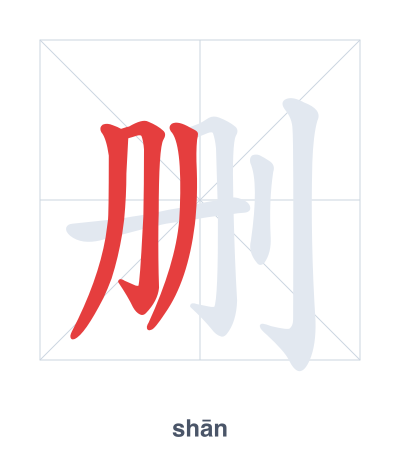
Open Hanzi Writer to see the animated stroke order and practice writing 删 with real-time feedback.
The character 删 (shān) is written with 7 strokes. Follow the standard Chinese stroke order: top to bottom, left to right, outside before inside. The radical 刂 is one of its key components.
Practice the correct stroke order with the Hanzi Writer app to see animated stroke-by-stroke guidance with real-time feedback.
删 means delete / cut / edit out.
As an HSK Level 7 character, 删 is an intermediate-level character.
删 combines 册 (bamboo book/scroll) and 刂 (knife). In ancient China, writing was on bamboo strips bound together; to delete or edit out text, one would physically cut away strips with a knife, so the character visually means 'cutting the book' to remove content.
💡 Memory Tip: Imagine a knife (刂) slicing through a stack of bamboo pages (册) to delete the unwanted words.
请删除这条信息。
qǐng shān chú zhè tiáo xìn xī
Please delete this message.
我把错字删掉了。
wǒ bǎ cuò zì shān diào le
I deleted the typo.
电影的内容有删减。
diàn yǐng de nèi róng yǒu shān jiǎn
The content of the movie has been edited.
Open Hanzi Writer to see the animated stroke order and practice writing 删 with real-time feedback.
✨ Animated stroke order · Handwriting recognition · HSK-graded practice · Free to use
删 is made of two parts: 册 (cè, meaning 'book' or 'volume') on the left and 刂 (the 'knife' radical) on the right. The knife radical suggests cutting or removing something from a book, which directly connects to the character's meaning of 'delete' or 'cut out'.