列 (liè) means "to list" in Chinese. It has 6 strokes with the radical 刂, and is HSK Level 4.
Rated 2.9/5 in difficulty (moderate).
Harder than 9% of HSK Level 4 characters.
Appears in 3+ common words including 列车 (liè chē), 排列 (pái liè), 列表 (liè biǎo).
Hanzi Writer's stroke validation shows learners typically need 5-8 attempts to write 列 with correct proportion and order.
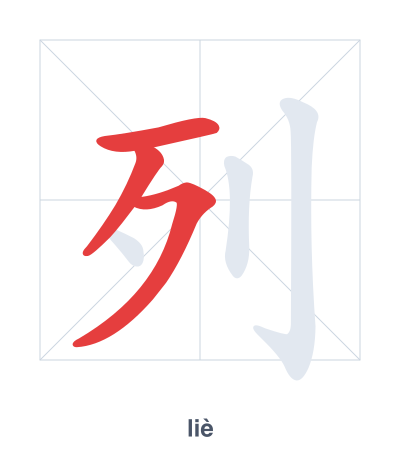
Open Hanzi Writer to see the animated stroke order and practice writing 列 with real-time feedback.
The character 列 (liè) is written with 6 strokes. Follow the standard Chinese stroke order: top to bottom, left to right, outside before inside. The radical 刂 is one of its key components.
Practice the correct stroke order with the Hanzi Writer app to see animated stroke-by-stroke guidance with real-time feedback.
列 means to list.
As an HSK Level 4 character, 列 is an intermediate-level character.
Originally a compound of 歹 (a broken bone, symbolizing death or remnants) and 刂 (knife), meaning to cut apart or separate. This sense of division evolved into arranging items in a sequence—essentially 'listing' them out in order.
💡 Memory Tip: Picture a knife (刂) slicing a row of broken bone pieces (歹) into a neat, ordered list on the ground.
列车准时出发。
liè chē zhǔn shí chū fā
The train departed on time.
请按顺序排列。
qǐng àn shùn xù pái liè
Please arrange them in order.
这是一个购物列表。
zhè shì yí gè gòu wù liè biǎo
This is a shopping list.
Open Hanzi Writer to see the animated stroke order and practice writing 列 with real-time feedback.
✨ Animated stroke order · Handwriting recognition · HSK-graded practice · Free to use
The character 列 combines the left radical 歹 (representing bones or a row) and the right radical 刂 (knife). The knife suggests cutting or separating, which connects to the idea of arranging items in a line. Together, they imply sorting or listing things in order.