Hanzi Writer

How to Write 梯 (tī) — Meaning “ladder; stairs”

HSK Level 4 11 strokes Radical: 木

梯 (tī) means "ladder; stairs" in Chinese. It has 11 strokes with the radical 木, and is HSK Level 4.

Rated 4.2/5 in difficulty (advanced).

Harder than 75% of HSK Level 4 characters.

Appears in 3+ common words including 电梯 (diàn tī), 楼梯 (lóu tī), 梯子 (tī zi).

Due to its 11 strokes, Hanzi Writer's error detection shows 梯 requires focused practice — most learners need 10+ attempts for consistent accuracy.
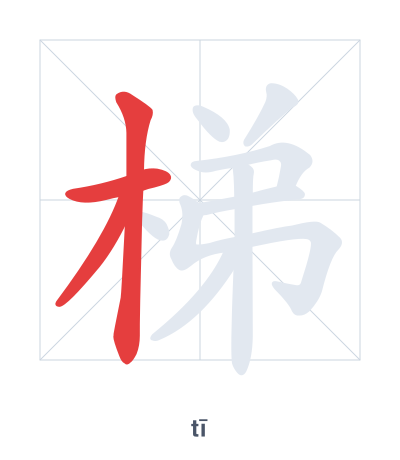
Stroke order practice for 梯 - tī

Practice Writing 梯 (tī)

Open Hanzi Writer to see the animated stroke order and practice writing 梯 with real-time feedback.

The character (tī) is written with 11 strokes. Follow the standard Chinese stroke order: top to bottom, left to right, outside before inside. The radical is one of its key components.

Practice the correct stroke order with the Hanzi Writer app to see animated stroke-by-stroke guidance with real-time feedback.

means ladder; stairs.

As an HSK Level 4 character, is an intermediate-level character.

Character
Pinyintī (ti)
Meaningladder; stairs
Strokes11
Radical
HSK Level4
Difficulty4.2/5

梯 is a phono-semantic compound combining the radical 木 (wood, the traditional material for ladders) with 弟 (younger brother), which provides the pronunciation tī. The shape of 弟 in ancient script may have also hinted at a rope ladder, reinforcing the meaning.

💡 Memory Tip: Imagine a wooden ladder (木) with your younger brother (弟) carefully climbing each rung.

diàn tī
elevator; lift
lóu tī
stairs; staircase
tī zi
ladder

我们坐电梯上楼吧。

wǒ men zuò diàn tī shàng lóu ba

Let's take the elevator upstairs.

他正在爬楼梯。

tā zhèng zài pá lóu tī

He is climbing the stairs.

请帮我扶一下梯子。

qǐng bāng wǒ fú yī xià tī zi

Please hold the ladder for me.

Character Pinyin Strokes Radical
(current) 11
9
píng 9
zhǐ 9
Stroke order practice for 梯 - tī

Practice Writing 梯 (tī)

Open Hanzi Writer to see the animated stroke order and practice writing 梯 with real-time feedback.

✨ Animated stroke order · Handwriting recognition · HSK-graded practice · Free to use

Frequently Asked Questions about 梯

梯 is made of two parts: the left radical 木 (wood) and the right component 弟 (younger brother). The 木 indicates that traditional ladders were made of wood, while 弟 gives a clue to the pronunciation (tī). Together, they form the character for "ladder" or "stairs."

More HSK Level 4 Characters

Characters with Radical 木

Other 11-Stroke Characters