枳 (zhǐ) means "trifoliate orange" in Chinese. It has 9 strokes with the radical 木.
Rated 4/5 in difficulty (challenging).
Appears in 3+ common words including 枳壳 (zhǐ ké), 枳实 (zhǐ shí), 枳机 (zhǐ jī).
Due to its 9 strokes, Hanzi Writer's error detection shows 枳 requires focused practice — most learners need 10+ attempts for consistent accuracy.
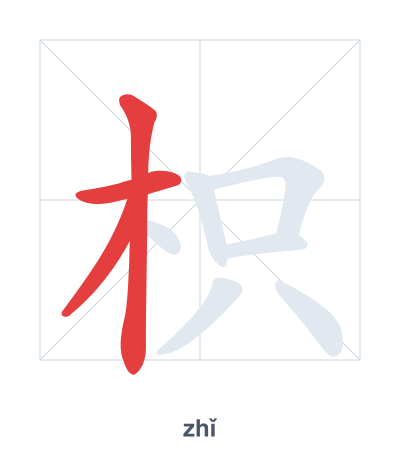
Open Hanzi Writer to see the animated stroke order and practice writing 枳 with real-time feedback.
The character 枳 (zhǐ) is written with 9 strokes. Follow the standard Chinese stroke order: top to bottom, left to right, outside before inside. The radical 木 is one of its key components.
Practice the correct stroke order with the Hanzi Writer app to see animated stroke-by-stroke guidance with real-time feedback.
枳 means trifoliate orange.
枳 is a phono-semantic compound: the left radical 木 (tree) indicates it is a type of woody plant, while the right component 只 (zhǐ) provides the pronunciation. Together they denote the trifoliate orange, a thorny citrus tree with three-lobed leaves.
💡 Memory Tip: Imagine a tree (木) with only (只) three leaves on each branch — that's the trifoliate orange.
枳壳是一种中药。
zhǐ ké shì yī zhǒng zhōng yào
Zhi Ke is a type of traditional Chinese medicine.
枳实的味道很苦。
zhǐ shí de wèi dào hěn kǔ
The taste of Zhi Shi is very bitter.
枳机草长得很高。
zhǐ jī cǎo zhǎng dé hěn gāo
The Achnatherum splendens grows very tall.
Open Hanzi Writer to see the animated stroke order and practice writing 枳 with real-time feedback.
✨ Animated stroke order · Handwriting recognition · HSK-graded practice · Free to use
枳 is a left-right character. The left part 木 (tree) shows it is a type of plant, and the right part 只 (zhǐ) gives the pronunciation. Together they mean "trifoliate orange," a citrus tree.