枯 (kū) means "withered; dried up" in Chinese. It has 9 strokes with the radical 木, and is HSK Level 7.
Rated 4/5 in difficulty (challenging).
Harder than 41% of HSK Level 7 characters.
Appears in 3+ common words including 枯萎 (kū wěi), 枯草 (kū cǎo), 枯燥 (kū zào).
Due to its 9 strokes, Hanzi Writer's error detection shows 枯 requires focused practice — most learners need 10+ attempts for consistent accuracy.
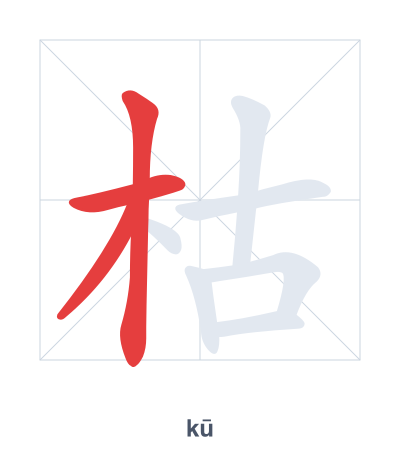
Open Hanzi Writer to see the animated stroke order and practice writing 枯 with real-time feedback.
The character 枯 (kū) is written with 9 strokes. Follow the standard Chinese stroke order: top to bottom, left to right, outside before inside. The radical 木 is one of its key components.
Practice the correct stroke order with the Hanzi Writer app to see animated stroke-by-stroke guidance with real-time feedback.
枯 means withered; dried up.
As an HSK Level 7 character, 枯 is an intermediate-level character.
枯 is a compound character with the radical 木 (tree) on the left and the phonetic component 古 (meaning 'old') on the right. An old tree naturally becomes withered and dried up over time, visually linking the components to the meaning.
💡 Memory Tip: Picture an old (古) tree (木) so dried and withered that its bark is cracking off.
花朵已经枯萎了。
huā duǒ yǐ jīng kū wěi le
The flowers have already withered.
这里的草都枯了。
zhè lǐ de cǎo dōu kū le
The grass here has all withered.
这本书的内容很枯燥。
zhè běn shū de nèi róng hěn kū zào
The content of this book is very dull.
Open Hanzi Writer to see the animated stroke order and practice writing 枯 with real-time feedback.
✨ Animated stroke order · Handwriting recognition · HSK-graded practice · Free to use
枯 is made of two parts: the left side 木 (tree) and the right side 古 (old). A tree that is old often becomes dry and withered, so the character's meaning 'withered' comes from this combination.