枰 (píng) means "chessboard" in Chinese. It has 9 strokes with the radical 木.
Rated 4/5 in difficulty (challenging).
Appears in 3+ common words including 棋枰 (qí píng), 枰面 (píng miàn), 枰场 (píng chǎng).
Due to its 9 strokes, Hanzi Writer's error detection shows 枰 requires focused practice — most learners need 10+ attempts for consistent accuracy.
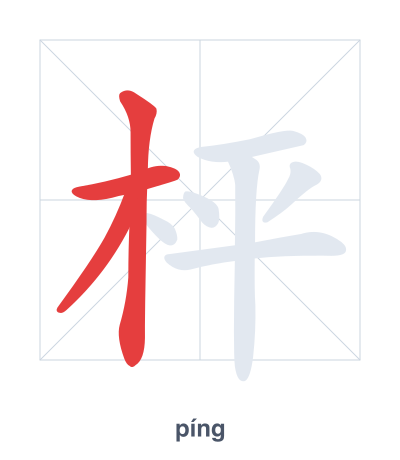
Open Hanzi Writer to see the animated stroke order and practice writing 枰 with real-time feedback.
The character 枰 (píng) is written with 9 strokes. Follow the standard Chinese stroke order: top to bottom, left to right, outside before inside. The radical 木 is one of its key components.
Practice the correct stroke order with the Hanzi Writer app to see animated stroke-by-stroke guidance with real-time feedback.
枰 means chessboard.
枰 is a compound character combining the radical 木 (wood/tree) and 平 (flat/level). The wood radical indicates the material, while 平 suggests a flat, level surface—together forming a flat wooden board used as a chessboard or game board.
💡 Memory Tip: Picture a flat wooden board (木) with perfectly level (平) grid lines where two players sit across from each other, ready to play a game of chess.
他在棋枰上放了一颗子。
tā zài qí píng shàng fàng le yī kē zi
He placed a piece on the chessboard.
枰面非常光滑。
píng miàn fēi cháng guāng huá
The surface of the chessboard is very smooth.
这是一个小枰场。
zhè shì yí gè xiǎo píng chǎng
This is a small threshing floor.
Open Hanzi Writer to see the animated stroke order and practice writing 枰 with real-time feedback.
✨ Animated stroke order · Handwriting recognition · HSK-graded practice · Free to use
枰 is composed of the radical 木 (wood/tree) on the left and 平 (píng, meaning flat or level) on the right. Since chessboards are traditionally made of wood and have a flat surface, the combination of 'wood' and 'flat' directly suggests the meaning of a chessboard.