楼 (lóu) means "building; floor" in Chinese. It has 13 strokes with the radical 木, and is HSK Level 1.
Rated 3.7/5 in difficulty (challenging).
Harder than 90% of HSK Level 1 characters.
Appears in 3+ common words including 大楼 (dà lóu), 上楼 (shàng lóu), 楼下 (lóu xià).
Due to its 13 strokes, Hanzi Writer's error detection shows 楼 requires focused practice — most learners need 10+ attempts for consistent accuracy.
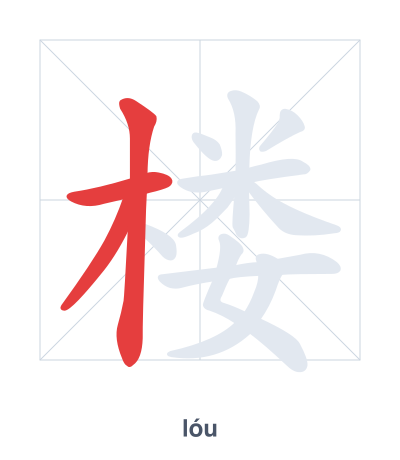
Open Hanzi Writer to see the animated stroke order and practice writing 楼 with real-time feedback.
The character 楼 (lóu) is written with 13 strokes. Follow the standard Chinese stroke order: top to bottom, left to right, outside before inside. The radical 木 is one of its key components.
Practice the correct stroke order with the Hanzi Writer app to see animated stroke-by-stroke guidance with real-time feedback.
楼 means building; floor.
As an HSK Level 1 character, 楼 is among the first characters beginners learn.
楼 combines the radical 木 (wood/tree) with the phonetic component 婁 (lóu), which originally depicted a woman with a basket on her head, suggesting stacking. Together, 楼 conveys a multi-story wooden structure, like a building with stacked floors.
💡 Memory Tip: Picture a tall wooden building (木) where each floor is a basket (婁) piled on top of another, stacking up to the sky.
我住在这栋大楼里。
wǒ zhù zài zhè dòng dà lóu lǐ
I live in this building.
我们一起上楼吧。
wǒ men yì qǐ shàng lóu ba
Let's go upstairs together.
他在楼下等你。
tā zài lóu xià děng nǐ
He is waiting for you downstairs.
Open Hanzi Writer to see the animated stroke order and practice writing 楼 with real-time feedback.
✨ Animated stroke order · Handwriting recognition · HSK-graded practice · Free to use
楼 is made of two parts: the left radical 木 (wood) and the right component 娄 (lóu). The 木 suggests that buildings were traditionally made of wood, while 娄 gives the pronunciation and hints at the structure's multiple levels (like a woman carrying rice upstairs).