谈 (tán) means "to talk or discuss" in Chinese. It has 10 strokes with the radical 讠, and is HSK Level 3.
Rated 3.9/5 in difficulty (challenging).
Harder than 59% of HSK Level 3 characters.
Appears in 3+ common words including 谈话 (tán huà), 谈判 (tán pàn), 谈心 (tán xīn).
Due to its 10 strokes, Hanzi Writer's error detection shows 谈 requires focused practice — most learners need 10+ attempts for consistent accuracy.
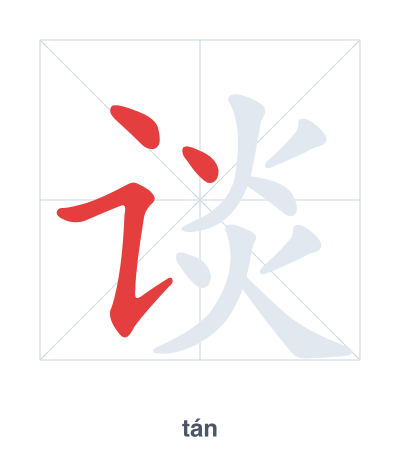
Open Hanzi Writer to see the animated stroke order and practice writing 谈 with real-time feedback.
The character 谈 (tán) is written with 10 strokes. Follow the standard Chinese stroke order: top to bottom, left to right, outside before inside. The radical 讠 is one of its key components.
Practice the correct stroke order with the Hanzi Writer app to see animated stroke-by-stroke guidance with real-time feedback.
谈 means to talk or discuss.
As an HSK Level 3 character, 谈 is an intermediate-level character.
谈 combines the speech radical 讠 (words) with 炎 (yán, flame), suggesting a passionate discussion that 'burns' with intense conversation. The character originally depicted speaking with heat, like a lively debate or fiery dialogue.
💡 Memory Tip: Picture two people chatting over a campfire (炎), their words sparking like flames as they talk (谈).
经理找我谈话了。
jīng lǐ zhǎo wǒ tán huà le
The manager had a talk with me.
双方正在进行谈判。
shuāng fāng zhèng zài jìn xíng tán pàn 。
Both sides are currently in negotiations.
今晚我们好好谈谈心。
jīn wǎn wǒ men hǎo hǎo tán tán xīn
Let's have a heart-to-heart talk tonight.
Open Hanzi Writer to see the animated stroke order and practice writing 谈 with real-time feedback.
✨ Animated stroke order · Handwriting recognition · HSK-graded practice · Free to use
谈 is made of two parts: the radical 讠 (speech) on the left and 炎 (yán, flame) on the right. The speech radical indicates this character relates to words or talking, while 炎 adds the sound tán and suggests lively, heated discussion. Together, they create the idea of ‘to talk or discuss.’