诓 (kuāng) means "To deceive; to cheat" in Chinese. It has 8 strokes with the radical 讠.
Rated 3.4/5 in difficulty (challenging).
Appears in 3+ common words including 诓骗 (kuāng piàn), 诓语 (kuāng yǔ), 诓人 (kuāng rén).
Due to its 8 strokes, Hanzi Writer's error detection shows 诓 requires focused practice — most learners need 10+ attempts for consistent accuracy.
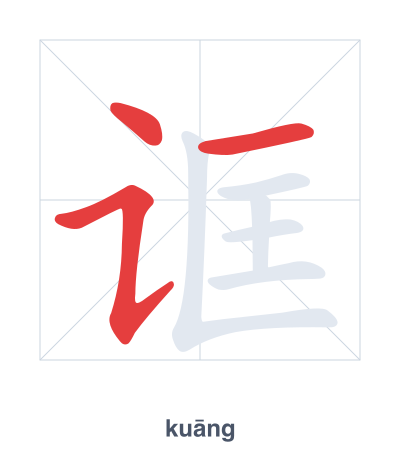
Open Hanzi Writer to see the animated stroke order and practice writing 诓 with real-time feedback.
The character 诓 (kuāng) is written with 8 strokes. Follow the standard Chinese stroke order: top to bottom, left to right, outside before inside. The radical 讠 is one of its key components.
Practice the correct stroke order with the Hanzi Writer app to see animated stroke-by-stroke guidance with real-time feedback.
诓 means To deceive; to cheat.
诓 is a phono-semantic compound. The radical 讠 (speech) indicates the meaning relates to words or speaking, while 匡 (kuāng) provides the pronunciation. Together, they suggest deceiving someone through speech.
💡 Memory Tip: Picture someone speaking (讠) while luring you into a box (匡) that turns out to be a trap—that's deception.
他在诓骗无辜的人。
tā zài kuāng piàn wú gū de rén
He is deceiving innocent people.
这只是一句诓语。
zhè zhǐ shì yī jù kuāng yǔ
This is just a lie.
你不要故意诓人。
nǐ bú yào gù yì kuāng rén
Don't trick people on purpose.
Open Hanzi Writer to see the animated stroke order and practice writing 诓 with real-time feedback.
✨ Animated stroke order · Handwriting recognition · HSK-graded practice · Free to use
The left side is 讠, the speech radical, which shows that the character is related to speaking or language. The right side is 匡 (kuāng), which gives the sound and also suggests a frame or box — together, they imply using words to "frame" someone, meaning to deceive.