痲 (má) means "numbness; leprosy" in Chinese. It has 13 strokes with the radical 疒.
Rated 4.2/5 in difficulty (advanced).
Appears in 3+ common words including 痲痺 (má bì), 痲木 (má mù), 痲疹 (má zhěn).
Due to its 13 strokes, Hanzi Writer's error detection shows 痲 requires focused practice — most learners need 10+ attempts for consistent accuracy.
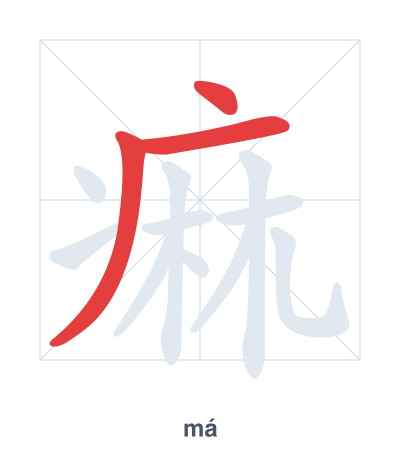
Open Hanzi Writer to see the animated stroke order and practice writing 痲 with real-time feedback.
The character 痲 (má) is written with 13 strokes. Follow the standard Chinese stroke order: top to bottom, left to right, outside before inside. The radical 疒 is one of its key components.
Practice the correct stroke order with the Hanzi Writer app to see animated stroke-by-stroke guidance with real-time feedback.
痲 means numbness; leprosy.
痲 combines the illness radical 疒 with 麻 (hemp), which gives both the sound 'ma' and the nuance of numbness—hemp fibers can cause a tingling sensation. Originally meaning leprosy, a disease that numbs the skin, it later extended to general numbness.
💡 Memory Tip: Picture a sick person (疒) lying under a heap of hemp plants (麻) that make their entire body go numb.
他的手脚感到痲痺。
tā de shǒu jiǎo gǎn dào má bì
His hands and feet feel numb.
他的双腿有些痲木。
tā de shuāng tuǐ yǒu xiē má mù
His legs are a bit numb.
孩子得了痲疹。
hái zi dé le má zhěn
The child has the measles.
Open Hanzi Writer to see the animated stroke order and practice writing 痲 with real-time feedback.
✨ Animated stroke order · Handwriting recognition · HSK-graded practice · Free to use
The character 痲 consists of the radical 疒 (sickness) on the left and 麻 (hemp; numb) on the right. The radical indicates it relates to illness, while 麻 suggests numbness or a rough, insensitive feeling like hemp fiber. Together they form the meaning of numbness or leprosy.