啼 (tí) means "to cry; to weep; (of birds) to chirp" in Chinese. It has 12 strokes with the radical 口.
Rated 4.2/5 in difficulty (advanced).
Appears in 3+ common words including 啼哭 (tí kū), 鸟啼 (niǎo tí), 啼叫 (tí jiào).
Due to its 12 strokes, Hanzi Writer's error detection shows 啼 requires focused practice — most learners need 10+ attempts for consistent accuracy.
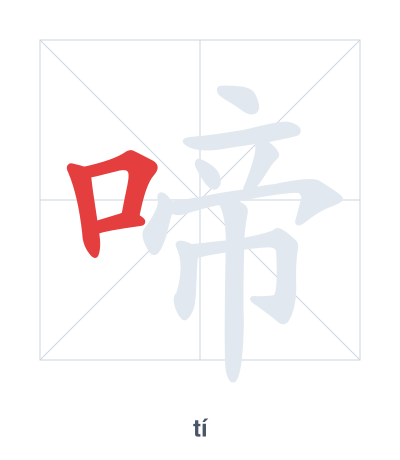
Open Hanzi Writer to see the animated stroke order and practice writing 啼 with real-time feedback.
The character 啼 (tí) is written with 12 strokes. Follow the standard Chinese stroke order: top to bottom, left to right, outside before inside. The radical 口 is one of its key components.
Practice the correct stroke order with the Hanzi Writer app to see animated stroke-by-stroke guidance with real-time feedback.
啼 means to cry; to weep; (of birds) to chirp.
啼 combines the mouth radical (口) representing vocal sound with 帝 (dì), a phonetic component that hints at the pronunciation 'tí'. It originally depicted the loud, piercing cries of a person or bird, similar to the exclamations of an emperor (帝).
💡 Memory Tip: Picture a bird perched on a crown (帝, emperor) opening its beak (口) to chirp loudly, waking everyone with its cries.
孩子在啼哭。
hái zi zài tí kū
The child is crying.
远处有鸟啼。
yuǎn chù yǒu niǎo tí
Birds were chirping in the distance.
公鸡在啼叫。
gōng jī zài tí jiào
The rooster is crowing.
Open Hanzi Writer to see the animated stroke order and practice writing 啼 with real-time feedback.
✨ Animated stroke order · Handwriting recognition · HSK-graded practice · Free to use
啼 is a left-right structure: the left side is 口 (mouth), the radical, and the right side is 帝 (dì, emperor). The mouth radical connects to sounds made by mouth, while 帝 suggests a high or loud cry, giving the meaning of crying or chirping.