声 (shēng) means "Sound; voice." in Chinese. It has 7 strokes with the radical 士, and is HSK Level 2.
Rated 2.9/5 in difficulty (moderate).
Harder than 37% of HSK Level 2 characters.
Appears in 3+ common words including 声音 (shēng yīn), 大声 (dà shēng), 掌声 (zhǎng shēng).
Hanzi Writer's stroke validation shows learners typically need 5-8 attempts to write 声 with correct proportion and order.
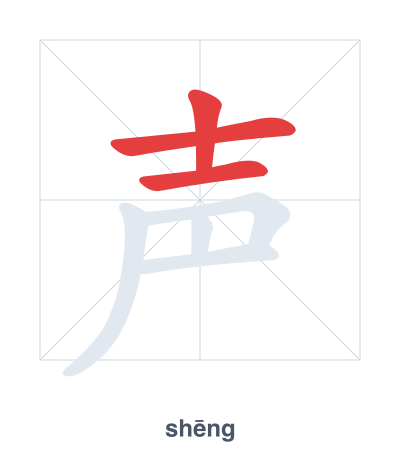
Open Hanzi Writer to see the animated stroke order and practice writing 声 with real-time feedback.
The character 声 (shēng) is written with 7 strokes. Follow the standard Chinese stroke order: top to bottom, left to right, outside before inside. The radical 士 is one of its key components.
Practice the correct stroke order with the Hanzi Writer app to see animated stroke-by-stroke guidance with real-time feedback.
声 means Sound; voice..
As an HSK Level 2 character, 声 is among the first characters beginners learn.
声 originates from the ancient character 聲, which depicted a hand holding a hammer striking a stone chime (殸) with an ear (耳) to perceive sound. The simplified 声 retains the top part of 殸, showing a hand (𠃜) and a chime (士 as a simplified representation), symbolizing the production of sound.
💡 Memory Tip: Picture a scholar (士) shouting, with his voice creating a curved sound wave (the hook below) radiating outward.
你的声音很大。
nǐ de shēng yīn hěn dà
Your voice is very loud.
请大声读课文。
qǐng dà shēng dú kè wén
Please read the text aloud.
教室里响起掌声。
jiào shì lǐ xiǎng qǐ zhǎng shēng
Applause broke out in the classroom.
Open Hanzi Writer to see the animated stroke order and practice writing 声 with real-time feedback.
✨ Animated stroke order · Handwriting recognition · HSK-graded practice · Free to use
声 combines the radical 士 (scholar) on top and 丿 (a slash) with 几 (table) below, but its historical form came from picturing a hand (又) holding an object near an ear (耳). The modern structure hints at sound rising from a mouth or object; the radical 士 gives a sense of 'standing' or 'prominent', connecting to how sound is produced and heard.