啻 (chì) means "only; merely" in Chinese. It has 12 strokes with the radical 口.
Rated 4.2/5 in difficulty (advanced).
Appears in 3+ common words including 不啻 (bù chì), 何啻 (hé chì), 奚啻 (xī chì).
Due to its 12 strokes, Hanzi Writer's error detection shows 啻 requires focused practice — most learners need 10+ attempts for consistent accuracy.
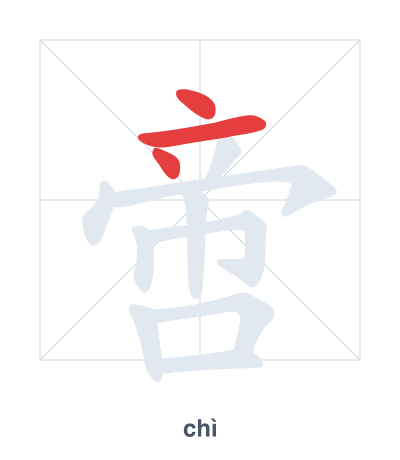
Open Hanzi Writer to see the animated stroke order and practice writing 啻 with real-time feedback.
The character 啻 (chì) is written with 12 strokes. Follow the standard Chinese stroke order: top to bottom, left to right, outside before inside. The radical 口 is one of its key components.
Practice the correct stroke order with the Hanzi Writer app to see animated stroke-by-stroke guidance with real-time feedback.
啻 means only; merely.
啻 combines 口 (mouth) and 帝 (emperor), suggesting the emperor's mouth speaks with absolute authority, leaving no room for alternatives—hence the meaning 'only' or 'merely.'
💡 Memory Tip: Imagine the emperor (帝) opening his mouth (口) to utter just one word, and everyone knows that word is the only thing that matters.
这不啻是好事。
zhè bù chì shì hǎo shì
This is no less than a good thing.
何啻千百人。
hé chì qiān bǎi rén
Far more than a thousand people.
奚啻如此。
xī chì rú cǐ
It is not only like this.
Open Hanzi Writer to see the animated stroke order and practice writing 啻 with real-time feedback.
✨ Animated stroke order · Handwriting recognition · HSK-graded practice · Free to use
啻 is made of two parts: the top is 帝 (emperor) and the bottom is 口 (mouth). The combination does not directly create the meaning "only; merely," but in classical Chinese it appears in fixed expressions like 不啻 (bù chì). The radical 口 suggests the character relates to speech or utterance.