讼 (sòng) means "Litigation / Lawsuit" in Chinese. It has 6 strokes with the radical 讠, and is HSK Level 7.
Rated 2.9/5 in difficulty (moderate).
Harder than 7% of HSK Level 7 characters.
Appears in 3+ common words including 诉讼 (sù sòng), 官讼 (guān sòng), 诉讼费 (sù sòng fèi).
Hanzi Writer's stroke validation shows learners typically need 5-8 attempts to write 讼 with correct proportion and order.
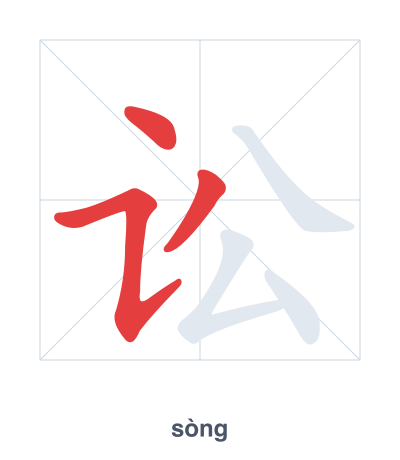
Open Hanzi Writer to see the animated stroke order and practice writing 讼 with real-time feedback.
The character 讼 (sòng) is written with 6 strokes. Follow the standard Chinese stroke order: top to bottom, left to right, outside before inside. The radical 讠 is one of its key components.
Practice the correct stroke order with the Hanzi Writer app to see animated stroke-by-stroke guidance with real-time feedback.
讼 means Litigation / Lawsuit.
As an HSK Level 7 character, 讼 is an intermediate-level character.
讼 combines the speech radical 讠 (言) with 公 (public), suggesting a 'public dispute' or debate over rights. Originally, it depicted bringing a conflict to public judgment, which evolved into the formal legal meaning of litigation or lawsuit.
💡 Memory Tip: Imagine two people shouting (讠) at each other in a public square (公) over a legal dispute.
他卷入了一场诉讼。
tā juǎn rù le yī cháng sù sòng
He was involved in a lawsuit.
这种官讼很麻烦。
zhè zhǒng guān sòng hěn má fán
This kind of lawsuit is very troublesome.
诉讼费非常贵。
sù sòng fèi fēi cháng guì
Legal fees are very expensive.
Open Hanzi Writer to see the animated stroke order and practice writing 讼 with real-time feedback.
✨ Animated stroke order · Handwriting recognition · HSK-graded practice · Free to use
讼 has the radical 讠 (speech) on the left and 公 (public) on the right. This suggests a public argument or dispute brought to a formal authority, which leads to the meaning of litigation or lawsuit.