诉 (sù) means "To tell / To complain / To sue" in Chinese. It has 7 strokes with the radical 讠, and is HSK Level 1.
Rated 2.7/5 in difficulty (moderate).
Harder than 48% of HSK Level 1 characters.
Appears in 3+ common words including 告诉 (gào sù), 投诉 (tóu sù), 起诉 (qǐ sù).
Hanzi Writer's stroke validation shows learners typically need 5-8 attempts to write 诉 with correct proportion and order.
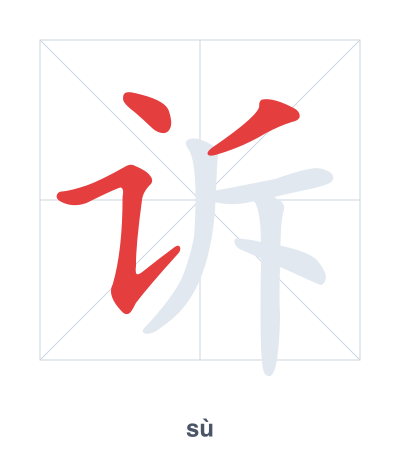
Open Hanzi Writer to see the animated stroke order and practice writing 诉 with real-time feedback.
The character 诉 (sù) is written with 7 strokes. Follow the standard Chinese stroke order: top to bottom, left to right, outside before inside. The radical 讠 is one of its key components.
Practice the correct stroke order with the Hanzi Writer app to see animated stroke-by-stroke guidance with real-time feedback.
诉 means To tell / To complain / To sue.
As an HSK Level 1 character, 诉 is among the first characters beginners learn.
诉 combines the speech radical 讠 (words) with 斥 (to reject or drive away), suggesting 'to speak out in rejection' — originally meaning to tell, complain, or sue. This compound visually shows someone voicing opposition or grievances.
💡 Memory Tip: Imagine a person (讠) pushing away a judge's gavel (the 斥 part) while shouting out a complaint in court.
请告诉他我的电话。
qǐng gào sù tā wǒ de diàn huà
Please give him my phone number.
我要投诉这家饭店。
wǒ yào tóu sù zhè jiā fàn diàn
I want to complain about this restaurant.
他决定起诉那家公司。
tā jué dìng qǐ sù nà jiā gōng sī
He decided to sue that company.
Open Hanzi Writer to see the animated stroke order and practice writing 诉 with real-time feedback.
✨ Animated stroke order · Handwriting recognition · HSK-graded practice · Free to use
The left side is 讠, the speech radical, meaning the character relates to speaking or words. The right side is 斥, which means to scold or blame. Together, 诉 means to tell, complain, or sue—actions done through speech, often with a negative or accusatory tone.