硕 (shuò) means "Large or eminent" in Chinese. It has 11 strokes with the radical 石, and is HSK Level 5.
Rated 4.2/5 in difficulty (advanced).
Harder than 83% of HSK Level 5 characters.
Appears in 3+ common words including 硕士 (shuò shì), 硕大 (shuò dà), 硕果 (shuò guǒ).
Due to its 11 strokes, Hanzi Writer's error detection shows 硕 requires focused practice — most learners need 10+ attempts for consistent accuracy.
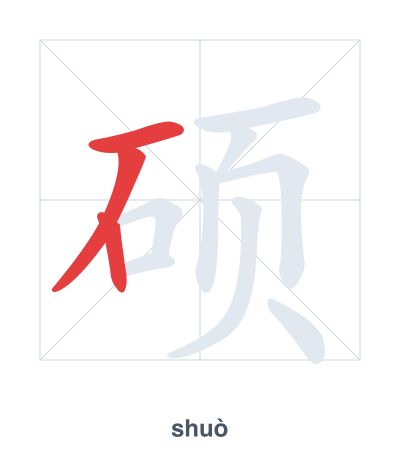
Open Hanzi Writer to see the animated stroke order and practice writing 硕 with real-time feedback.
The character 硕 (shuò) is written with 11 strokes. Follow the standard Chinese stroke order: top to bottom, left to right, outside before inside. The radical 石 is one of its key components.
Practice the correct stroke order with the Hanzi Writer app to see animated stroke-by-stroke guidance with real-time feedback.
硕 means Large or eminent.
As an HSK Level 5 character, 硕 is an intermediate-level character.
硕 is a phono-semantic compound. The left component 页 (head) indicates the original meaning 'large head,' while 石 (stone) provides the sound. Over time, the meaning expanded from 'large head' to describe anything large or eminent.
💡 Memory Tip: Imagine a stone (石) head (页) that is enormous—that's a truly 'large' head!
他在读硕士学位。
tā zài dú shuò shì xué wèi
He is studying for a master's degree.
树上结了硕大的果实。
shù shàng jié le shuò dà de guǒ shí
The tree has borne massive fruit.
这是他努力的硕果。
zhè shì tā nǔ lì de shuò guǒ
This is the fruit of his hard work.
Open Hanzi Writer to see the animated stroke order and practice writing 硕 with real-time feedback.
✨ Animated stroke order · Handwriting recognition · HSK-graded practice · Free to use
硕 combines the radical 石 (stone) on the left with the phonetic component 页 (page/head) on the right. The stone radical hints at solidity and size, while 页 originally depicted a person's head, together suggesting something large or eminent like a big stone head.