砉 (huò) means "sound of cutting or whistling" in Chinese. It has 9 strokes with the radical 石.
Rated 4/5 in difficulty (challenging).
Appears in 3+ common words including 砉然 (huò rán), 砉的一声 (huò de yī shēng), 砉划 (huò huà).
Due to its 9 strokes, Hanzi Writer's error detection shows 砉 requires focused practice — most learners need 10+ attempts for consistent accuracy.
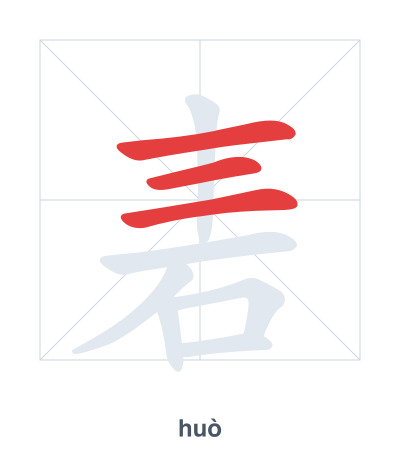
Open Hanzi Writer to see the animated stroke order and practice writing 砉 with real-time feedback.
The character 砉 (huò) is written with 9 strokes. Follow the standard Chinese stroke order: top to bottom, left to right, outside before inside. The radical 石 is one of its key components.
Practice the correct stroke order with the Hanzi Writer app to see animated stroke-by-stroke guidance with real-time feedback.
砉 means sound of cutting or whistling.
砉 combines the radical 石 (stone) with 㐄, an ancient pictograph of a cutting tool, suggesting the sound produced when stone strikes or slices. The top component visually echoes the motion of a blade, while the stone base grounds the meaning in a hard object that could make a sharp whistling noise upon impact.
💡 Memory Tip: Picture a stone (石) meeting a cross-shaped blade (㐄) in mid-air with a crisp 'huò' whistle.
砉然一声,门开了。
huò rán yī shēng mén kāi le
With a sudden sound, the door opened.
砉的一声,树枝断了。
huò de yī shēng shù zhī duàn le
With a crack, the branch broke.
船桨砉划水面。
chuán jiǎng huò huà shuǐ miàn
The oar splashed through the water.
Open Hanzi Writer to see the animated stroke order and practice writing 砉 with real-time feedback.
✨ Animated stroke order · Handwriting recognition · HSK-graded practice · Free to use
砉 is composed of the radical 石 (stone) on top and 丰 (abundant) on the bottom. The radical suggests a connection to stone or hard surfaces, while the whole character represents the sound of cutting or whistling, often associated with a sharp action against a hard material.