柿 (shì) means "persimmon" in Chinese. It has 9 strokes with the radical 木, and is HSK Level 5.
Rated 4/5 in difficulty (challenging).
Harder than 52% of HSK Level 5 characters.
Appears in 3+ common words including 柿子 (shì zi), 西红柿 (xī hóng shì), 柿饼 (shì bǐng).
Due to its 9 strokes, Hanzi Writer's error detection shows 柿 requires focused practice — most learners need 10+ attempts for consistent accuracy.
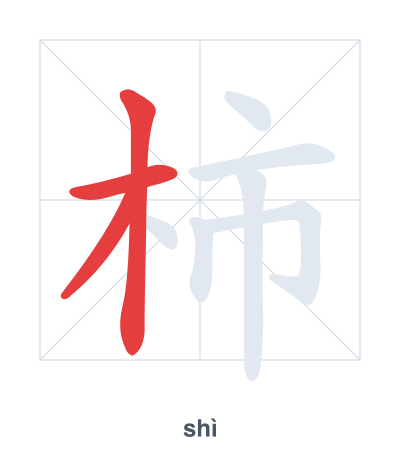
Open Hanzi Writer to see the animated stroke order and practice writing 柿 with real-time feedback.
The character 柿 (shì) is written with 9 strokes. Follow the standard Chinese stroke order: top to bottom, left to right, outside before inside. The radical 木 is one of its key components.
Practice the correct stroke order with the Hanzi Writer app to see animated stroke-by-stroke guidance with real-time feedback.
柿 means persimmon.
As an HSK Level 5 character, 柿 is an intermediate-level character.
柿 is a phono-semantic compound: the radical 木 (tree) indicates it's a tree, and the component 市 (market, pronounced shì) serves as a phonetic hint for the pronunciation, together referring to the persimmon tree and its fruit.
💡 Memory Tip: Picture a market stall (市) set up under a persimmon tree (木), where bright orange fruits hang like lanterns over the hustle.
这个柿子很甜。
zhè ge shì zi hěn tián
This persimmon is very sweet.
我喜欢吃西红柿。
wǒ xǐ huān chī xī hóng shì
I like eating tomatoes.
奶奶买了些柿饼。
nǎi nǎi mǎi le xiē shì bǐng
Grandma bought some dried persimmons.
Open Hanzi Writer to see the animated stroke order and practice writing 柿 with real-time feedback.
✨ Animated stroke order · Handwriting recognition · HSK-graded practice · Free to use
The character 柿 is composed of the radical 木 (tree) on the left and 市 (market) on the right. The tree radical shows it is related to plants, and the right part gives the pronunciation shì. Together they form the word for persimmon, a fruit that grows on trees.