杉 (shān) means "Fir; cedar" in Chinese. It has 7 strokes with the radical 木.
Rated 3.5/5 in difficulty (challenging).
Appears in 3+ common words including 杉树 (shān shù), 水杉 (shuǐ shān), 云杉 (yún shān).
Due to its 7 strokes, Hanzi Writer's error detection shows 杉 requires focused practice — most learners need 10+ attempts for consistent accuracy.
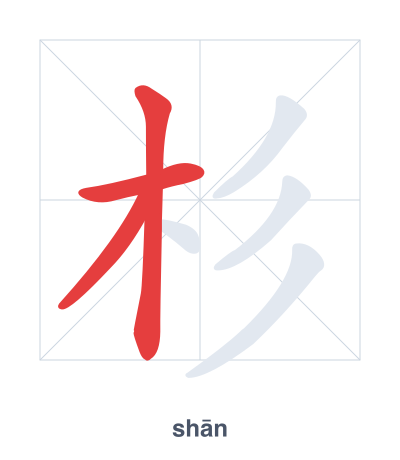
Open Hanzi Writer to see the animated stroke order and practice writing 杉 with real-time feedback.
The character 杉 (shān) is written with 7 strokes. Follow the standard Chinese stroke order: top to bottom, left to right, outside before inside. The radical 木 is one of its key components.
Practice the correct stroke order with the Hanzi Writer app to see animated stroke-by-stroke guidance with real-time feedback.
杉 means Fir; cedar.
杉 is a phono-semantic compound: the radical 木 (tree) indicates it is a type of tree, while 彡 (shān) provides the pronunciation and visually resembles the three-pronged needles or branches of conifers like firs and cedars.
💡 Memory Tip: Picture a tree (木) with three distinct strokes (彡) on its right side, like three pine needles or branches—that's the fir tree.
山上有许多杉树。
shān shàng yǒu xǔ duō shān shù
There are many fir trees on the mountain.
水杉的叶子很漂亮。
shuǐ shān de yè zi hěn piào liàng
The leaves of the dawn redwood are very beautiful.
云杉长得非常高。
yún shān zhǎng dé fēi cháng gāo
Spruce trees grow very tall.
Open Hanzi Writer to see the animated stroke order and practice writing 杉 with real-time feedback.
✨ Animated stroke order · Handwriting recognition · HSK-graded practice · Free to use
杉 is composed of the radical 木 (wood/tree) on the left and 彡 (shān, three strokes or hair/feather-like pattern) on the right. The 木 radical indicates it is a type of tree, while 彡 adds a phonetic hint: both the character and its right component are pronounced shān. So the structure combines the meaning of 'tree' with a sound clue.