似 (shì/sì) means "to seem; to be like" in Chinese. It has 6 strokes with the radical 亻, and is HSK Level 3.
Rated 2.9/5 in difficulty (moderate).
Harder than 19% of HSK Level 3 characters.
Appears in 3+ common words including 似乎 (sì hū), 相似 (xiāng sì), 似的 (shì de).
Hanzi Writer's stroke validation shows learners typically need 5-8 attempts to write 似 with correct proportion and order.
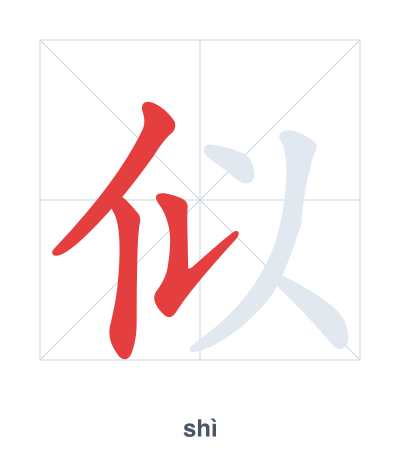
Open Hanzi Writer to see the animated stroke order and practice writing 似 with real-time feedback.
The character 似 (shì/sì) is written with 6 strokes. Follow the standard Chinese stroke order: top to bottom, left to right, outside before inside. The radical 亻 is one of its key components.
Practice the correct stroke order with the Hanzi Writer app to see animated stroke-by-stroke guidance with real-time feedback.
似 means to seem; to be like.
This is a polyphonic character with readings: shì, sì.
As an HSK Level 3 character, 似 is an intermediate-level character.
似 combines the radical 亻 (person) with 以 (yǐ, 'to use'). Originally, 以 depicted a person carrying a tool, suggesting 'to use' or 'to act'; together, they signify a person using something to resemble or appear like another.
💡 Memory Tip: A person (亻) uses (以) a mask to seem like someone else.
天阴了,似乎很快就要下雨了。
tiān yīn le sì hū hěn kuài jiù yào xià yǔ le
The sky is overcast; it looks like it will rain soon.
这两兄弟长得非常相似,外人很难分辨。
zhè liǎng xiōng dì zhǎng dé fēi cháng xiāng sì wài rén hěn nán fēn biàn
These two brothers look very similar; it's hard for outsiders to tell them apart.
他跑得飞快,像一阵风似的掠过。
tā pǎo dé fēi kuài xiàng yī zhèn fēng shì de lüè guò
He ran very fast, sweeping past like a gust of wind.
Open Hanzi Writer to see the animated stroke order and practice writing 似 with real-time feedback.
✨ Animated stroke order · Handwriting recognition · HSK-graded practice · Free to use
似 is made of the radical 亻 (person on the left) and the phonetic component 以 (yǐ, meaning 'to use') on the right. The person radical suggests a human action or quality, while 以 hints at the sound 'shì' and the idea of 'using something as a model,' together giving the meaning 'to seem' or 'to be like.'