乎 (hū) means "(classical particle) / expressing doubt" in Chinese. It has 5 strokes with the radical 丿, and is HSK Level 4.
Rated 2.7/5 in difficulty (moderate).
Harder than 5% of HSK Level 4 characters.
Appears in 3+ common words including 几乎 (jī hū), 似乎 (sì hū), 在乎 (zài hū).
Hanzi Writer's stroke validation shows learners typically need 5-8 attempts to write 乎 with correct proportion and order.
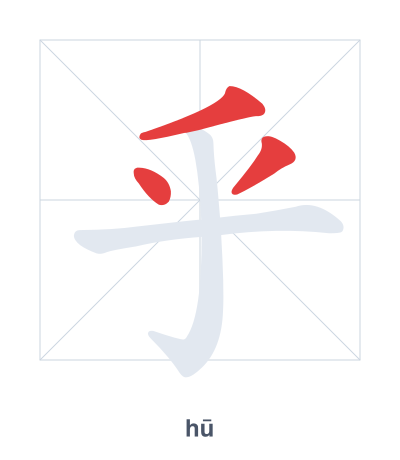
Open Hanzi Writer to see the animated stroke order and practice writing 乎 with real-time feedback.
The character 乎 (hū) is written with 5 strokes. Follow the standard Chinese stroke order: top to bottom, left to right, outside before inside. The radical 丿 is one of its key components.
Practice the correct stroke order with the Hanzi Writer app to see animated stroke-by-stroke guidance with real-time feedback.
乎 means (classical particle) / expressing doubt.
As an HSK Level 4 character, 乎 is an intermediate-level character.
乎 originally depicted a puff of air rising from a mouth, representing a call or exclamation. Over time, it became a classical particle expressing doubt or questioning, much like a spoken 'huh?' The top stroke (丿) suggests the escaping breath, while the lower structure hints at the mouth shape.
💡 Memory Tip: Imagine a figure with a raised hand (丿) and a slanted body (looks like a question mark) asking 'Huh?'—乎 is the sound of doubt.
我几乎忘了。
wǒ jī hū wàng le
I almost forgot.
他似乎不开心。
tā sì hū bù kāi xīn
He seems unhappy.
我不在乎。
wǒ bù zài hū
I don't care.
Open Hanzi Writer to see the animated stroke order and practice writing 乎 with real-time feedback.
✨ Animated stroke order · Handwriting recognition · HSK-graded practice · Free to use
The character 乎 consists of a radical 丿 (a left-falling stroke) on top and a lower component that looks like a curved hook. This structure does not directly depict its meaning as a classical particle; instead, it is a phonetic loan character used for expressing doubt or question in classical Chinese.