设 (shè) means "To set up / To establish / To design" in Chinese. It has 6 strokes with the radical 讠, and is HSK Level 3.
Rated 2.9/5 in difficulty (moderate).
Harder than 25% of HSK Level 3 characters.
Appears in 3+ common words including 设计 (shè jì), 建设 (jiàn shè), 假设 (jiǎ shè).
Hanzi Writer's stroke validation shows learners typically need 5-8 attempts to write 设 with correct proportion and order.
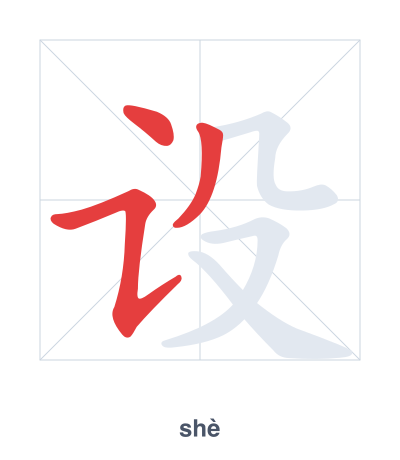
Open Hanzi Writer to see the animated stroke order and practice writing 设 with real-time feedback.
The character 设 (shè) is written with 6 strokes. Follow the standard Chinese stroke order: top to bottom, left to right, outside before inside. The radical 讠 is one of its key components.
Practice the correct stroke order with the Hanzi Writer app to see animated stroke-by-stroke guidance with real-time feedback.
设 means To set up / To establish / To design.
As an HSK Level 3 character, 设 is an intermediate-level character.
设 combines the speech radical 讠 (words) with 殳 (a hand holding a tool or weapon). Originally it meant 'to arrange' or 'to set up' something, like placing words or plans in order, and the 殳 component suggests the decisive action of establishing or deploying.
💡 Memory Tip: Imagine a speaker (讠) using a hand (殳, shaped like a hook) to set up a stage — that's 设.
他设计了这件衣服。
tā shè jì le zhè jiàn yī fú
He designed this piece of clothing.
城市建设很快。
chéng shì jiàn shè hěn kuài
City construction is very fast.
这是一个假设。
zhè shì yí gè jiǎ shè
This is a hypothesis.
Open Hanzi Writer to see the animated stroke order and practice writing 设 with real-time feedback.
✨ Animated stroke order · Handwriting recognition · HSK-graded practice · Free to use
设 (shè) has the radical 讠 (speech) on the left and the component “殳” (shū, a weapon or action) on the right. The speech radical connects to communicating or planning, while “殳” suggests carrying out an action, together meaning "to set up, establish, or design" through speaking and doing.