赡 (shàn) means "To support / To provide for" in Chinese. It has 17 strokes with the radical 贝, and is HSK Level 7.
Rated 4.2/5 in difficulty (advanced).
Harder than 91% of HSK Level 7 characters.
Appears in 3+ common words including 赡养 (shàn yǎng), 赡养费 (shàn yǎng fèi), 赡养人 (shàn yǎng rén).
Due to its 17 strokes, Hanzi Writer's error detection shows 赡 requires focused practice — most learners need 10+ attempts for consistent accuracy.
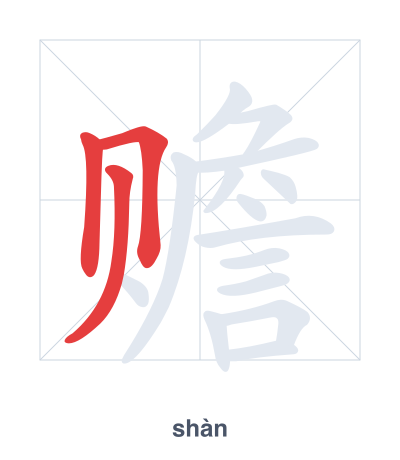
Open Hanzi Writer to see the animated stroke order and practice writing 赡 with real-time feedback.
The character 赡 (shàn) is written with 17 strokes. Follow the standard Chinese stroke order: top to bottom, left to right, outside before inside. The radical 贝 is one of its key components.
Practice the correct stroke order with the Hanzi Writer app to see animated stroke-by-stroke guidance with real-time feedback.
赡 means To support / To provide for.
As an HSK Level 7 character, 赡 is an intermediate-level character.
This compound character combines the radical 贝 (shell, representing money/wealth) with the phonetic component 詹 (zhān, meaning 'to talk' or 'to look up'). The visual suggests that to support or provide for someone requires both financial resources (贝) and verbal commitment (詹).
💡 Memory Tip: Picture a wealthy person (贝) standing under a roof (厃) giving a speech (言) about how they will provide for everyone.
子女要赡养老人。
zǐ nǚ yào shàn yǎng lǎo rén
Children should support the elderly.
他按时给赡养费。
tā àn shí gěi shàn yǎng fèi
He pays alimony on time.
谁是他的赡养人?
shuí shì tā de shàn yǎng rén
Who is his supporter?
Open Hanzi Writer to see the animated stroke order and practice writing 赡 with real-time feedback.
✨ Animated stroke order · Handwriting recognition · HSK-graded practice · Free to use
The character 赡 is made of the radical 贝 on the left, which means "shell" or "money," and the component 詹 on the right. Since providing support often involves money or resources, the 贝 radical directly hints at the character's financial meaning.