赝 (yàn) means "Fake / Counterfeit" in Chinese. It has 16 strokes with the radical 贝.
Rated 4.2/5 in difficulty (advanced).
Appears in 3+ common words including 赝品 (yàn pǐn), 赝本 (yàn běn), 辨赝 (biàn yàn).
Due to its 16 strokes, Hanzi Writer's error detection shows 赝 requires focused practice — most learners need 10+ attempts for consistent accuracy.
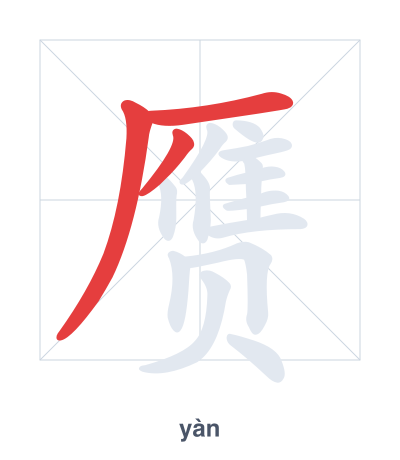
Open Hanzi Writer to see the animated stroke order and practice writing 赝 with real-time feedback.
The character 赝 (yàn) is written with 16 strokes. Follow the standard Chinese stroke order: top to bottom, left to right, outside before inside. The radical 贝 is one of its key components.
Practice the correct stroke order with the Hanzi Writer app to see animated stroke-by-stroke guidance with real-time feedback.
赝 means Fake / Counterfeit.
This character is a phonetic-semantic compound. The radical 贝 (shell/money) indicates its connection to valuable items or currency, while the component 雁 (yàn, wild goose) provides the pronunciation. Together, they depict a counterfeit item, like a fake shell used as money.
💡 Memory Tip: Imagine a wild goose (雁) trying to sell a shell (贝) that's clearly made of plastic—it's a fake.
这幅画是赝品。
zhè fú huà shì yàn pǐn
This painting is a forgery.
他买到了赝本。
tā mǎi dào le yàn běn
He bought a counterfeit copy.
专家正在辨赝。
zhuān jiā zhèng zài biàn yàn
Experts are identifying forgeries.
Open Hanzi Writer to see the animated stroke order and practice writing 赝 with real-time feedback.
✨ Animated stroke order · Handwriting recognition · HSK-graded practice · Free to use
赝 is made of two parts: the top is 雁 (yàn, wild goose) and the bottom is 贝 (bèi, shell/money). The 贝 radical suggests the idea of value or currency, while the goose component gives a hint to the pronunciation. Together, they create the concept of something falsely pretending to have value, like counterfeit money or a fake item.