蹂 (róu) means "To trample; to tread on" in Chinese. It has 16 strokes with the radical 足.
Rated 4.2/5 in difficulty (advanced).
Appears in 3+ common words including 蹂躏 (róu lìn), 蹂踏 (róu tà), 蹂 (róu).
Due to its 16 strokes, Hanzi Writer's error detection shows 蹂 requires focused practice — most learners need 10+ attempts for consistent accuracy.
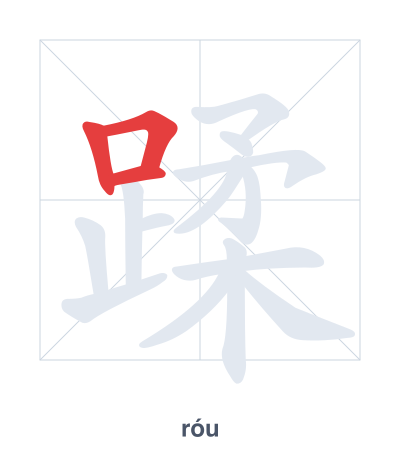
Open Hanzi Writer to see the animated stroke order and practice writing 蹂 with real-time feedback.
The character 蹂 (róu) is written with 16 strokes. Follow the standard Chinese stroke order: top to bottom, left to right, outside before inside. The radical 足 is one of its key components.
Practice the correct stroke order with the Hanzi Writer app to see animated stroke-by-stroke guidance with real-time feedback.
蹂 means To trample; to tread on.
This character is a phono-semantic compound: the radical 足 (foot) shows the action of stepping, and the component 柔 (róu, 'soft') provides the sound while hinting at the softness of what is being trampled.
💡 Memory Tip: Imagine a giant foot (足) squishing soft, tender (柔) grass or dough under its weight.
战争蹂躏了这片土地。
zhàn zhēng róu lìn le zhè piàn tǔ dì
War ravaged this land.
不要蹂踏公园的草坪。
bú yào róu tà gōng yuán de cǎo píng
Don't trample the park's lawn.
庄稼被大雨蹂躏了。
zhuāng jià bèi dà yǔ róu lìn le
The crops were devastated by the heavy rain.
Open Hanzi Writer to see the animated stroke order and practice writing 蹂 with real-time feedback.
✨ Animated stroke order · Handwriting recognition · HSK-graded practice · Free to use
The character 蹂 is composed of the radical 足 (foot) on the left and the phonetic component 柔 (róu, meaning soft) on the right. The foot radical suggests an action done with the foot, while 柔 provides the pronunciation and adds a sense of pressing or rubbing onto something soft.