躏 (lìn) means "to trample; to oppress" in Chinese. It has 21 strokes with the radical 足.
Rated 4.2/5 in difficulty (advanced).
Appears in 3+ common words including 蹂躏 (róu lìn), 践躏 (jiàn lìn), 躏藉 (lìn jí).
Due to its 21 strokes, Hanzi Writer's error detection shows 躏 requires focused practice — most learners need 10+ attempts for consistent accuracy.
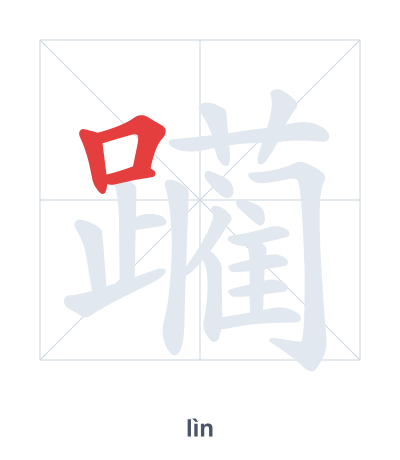
Open Hanzi Writer to see the animated stroke order and practice writing 躏 with real-time feedback.
The character 躏 (lìn) is written with 21 strokes. Follow the standard Chinese stroke order: top to bottom, left to right, outside before inside. The radical 足 is one of its key components.
Practice the correct stroke order with the Hanzi Writer app to see animated stroke-by-stroke guidance with real-time feedback.
躏 means to trample; to oppress.
This compound character is formed from the radical 足 (foot) and the phonetic component 蔺 (lìn, a type of rush plant). The foot radical suggests the action of stepping or trampling, while the phonetic hints at the pronunciation. Together, they convey the meaning of trampling or oppressing underfoot.
💡 Memory Tip: Picture a heavy boot (足) stomping on a bundle of withered grass (蔺's inner components like 门 and 艹) until it is crushed flat.
战争蹂躏了家园。
zhàn zhēng róu lìn le jiā yuán
War ravaged the homeland.
不要践躏草坪。
bú yào jiàn lìn cǎo píng
Don't trample the lawn.
花朵被风雨躏藉。
huā duǒ bèi fēng yǔ lìn jí
The flowers were ravaged by the wind and rain.
Open Hanzi Writer to see the animated stroke order and practice writing 躏 with real-time feedback.
✨ Animated stroke order · Handwriting recognition · HSK-graded practice · Free to use
The left side is the radical 足, meaning "foot," which hints at the action of trampling. The right side is 蔺, which provides the pronunciation lìn. Together, the character suggests a foot performing an oppressive action.