泉 (quán) means "Spring (water); fountain" in Chinese. It has 9 strokes with the radical 水, and is HSK Level 4.
Rated 4/5 in difficulty (challenging).
Harder than 60% of HSK Level 4 characters.
Appears in 3+ common words including 泉水 (quán shuǐ), 温泉 (wēn quán), 喷泉 (pēn quán).
Due to its 9 strokes, Hanzi Writer's error detection shows 泉 requires focused practice — most learners need 10+ attempts for consistent accuracy.
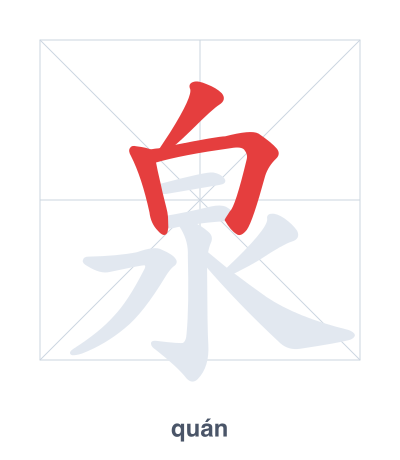
Open Hanzi Writer to see the animated stroke order and practice writing 泉 with real-time feedback.
The character 泉 (quán) is written with 9 strokes. Follow the standard Chinese stroke order: top to bottom, left to right, outside before inside. The radical 水 is one of its key components.
Practice the correct stroke order with the Hanzi Writer app to see animated stroke-by-stroke guidance with real-time feedback.
泉 means Spring (water); fountain.
As an HSK Level 4 character, 泉 is an intermediate-level character.
The ancient form of 泉 depicted water flowing from a natural spring or cave; the modern character combines 白 (originally a symbol of the source or opening) above 水 (water), showing water emerging from the ground.
💡 Memory Tip: Picture a white (白) stone fountain where clear water (水) bubbles up, forming a natural spring.
泉水非常清甜。
quán shuǐ fēi cháng qīng tián
The spring water is very clear and sweet.
我们去泡温泉吧。
wǒ men qù pào wēn quán ba
Let's go to the hot springs.
广场上有喷泉。
guǎng chǎng shàng yǒu pēn quán
There is a fountain in the square.
Open Hanzi Writer to see the animated stroke order and practice writing 泉 with real-time feedback.
✨ Animated stroke order · Handwriting recognition · HSK-graded practice · Free to use
泉 is made of two parts: 白 (white) on top and 水 (water) below. Together, they suggest clear, white water flowing from a spring. This structure directly represents the meaning of a natural spring or fountain.