泵 (bèng) means "pump" in Chinese. It has 9 strokes with the radical 水.
Rated 4/5 in difficulty (challenging).
Appears in 3+ common words including 水泵 (shuǐ bèng), 气泵 (qì bèng), 油泵 (yóu bèng).
Due to its 9 strokes, Hanzi Writer's error detection shows 泵 requires focused practice — most learners need 10+ attempts for consistent accuracy.
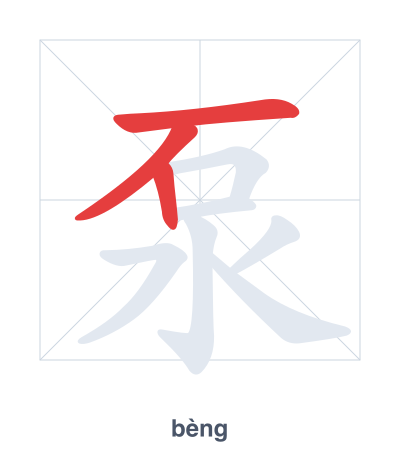
Open Hanzi Writer to see the animated stroke order and practice writing 泵 with real-time feedback.
The character 泵 (bèng) is written with 9 strokes. Follow the standard Chinese stroke order: top to bottom, left to right, outside before inside. The radical 水 is one of its key components.
Practice the correct stroke order with the Hanzi Writer app to see animated stroke-by-stroke guidance with real-time feedback.
泵 means pump.
| Character | 泵 |
| Pinyin | bèng (beng) |
| Meaning | pump |
| Strokes | 9 |
| Radical | 水 |
| Difficulty | 4/5 |
泵 combines 'stone' (石) on top of 'water' (水), visually suggesting a heavy stone pressing down to force water upward—a simple depiction of a pump's action.
💡 Memory Tip: Picture a stone (石) plunging into water (水) and splashing out a steady pump stream.
这个水泵坏了。
zhè ge shuǐ bèng huài le
This water pump is broken.
气泵在车库里。
qì bèng zài chē kù lǐ
The air pump is in the garage.
汽车需要换油泵。
qì chē xū yào huàn yóu bèng
The car needs a new fuel pump.
Open Hanzi Writer to see the animated stroke order and practice writing 泵 with real-time feedback.
✨ Animated stroke order · Handwriting recognition · HSK-graded practice · Free to use
The character 泵 is made of two parts: 石 (stone) on top and 水 (water) below. The bottom 水 directly relates to the pump's function of moving water, while the top 石 provides a visual hint, though its exact role is uncertain. Together, the structure suggests a device that handles water.