嵌 (qiàn) means "To embed / to inlay" in Chinese. It has 12 strokes with the radical 山, and is HSK Level 7.
Rated 4.2/5 in difficulty (advanced).
Harder than 54% of HSK Level 7 characters.
Appears in 3+ common words including 嵌入 (qiàn rù), 镶嵌 (xiāng qiàn), 嵌在 (qiàn zài).
Due to its 12 strokes, Hanzi Writer's error detection shows 嵌 requires focused practice — most learners need 10+ attempts for consistent accuracy.
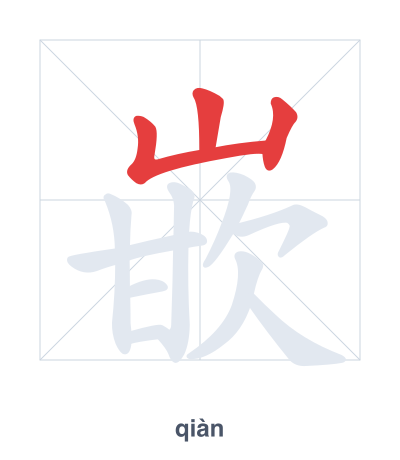
Open Hanzi Writer to see the animated stroke order and practice writing 嵌 with real-time feedback.
The character 嵌 (qiàn) is written with 12 strokes. Follow the standard Chinese stroke order: top to bottom, left to right, outside before inside. The radical 山 is one of its key components.
Practice the correct stroke order with the Hanzi Writer app to see animated stroke-by-stroke guidance with real-time feedback.
嵌 means To embed / to inlay.
As an HSK Level 7 character, 嵌 is an intermediate-level character.
The character 嵌 combines the radical 山 (mountain) with a lower part that consists of 甘 (sweet) and 欠 (to lack/yawn). This composition suggests a mountain with a cavity or hole (represented by 欠) into which something sweet or precious is set, reflecting the meaning 'to embed' or 'to inlay.'
💡 Memory Tip: Imagine a mountain (山) with a sweet candy (甘) missing a piece (欠), so you embed a shiny gem into the hole to fix it.
手机卡嵌入了槽位。
shǒu jī kǎ qiàn rù le cáo wèi
The SIM card is inserted into the slot.
戒指上镶嵌着钻石。
jiè zhǐ shàng xiāng qiàn zhe zuàn shí
The ring is set with diamonds.
宝石嵌在项链里。
bǎo shí qiàn zài xiàng liàn lǐ
The gemstone is embedded in the necklace.
Open Hanzi Writer to see the animated stroke order and practice writing 嵌 with real-time feedback.
✨ Animated stroke order · Handwriting recognition · HSK-graded practice · Free to use
The character 嵌 is made of 山 (mountain) on top and 欠 (qiàn, meaning 'to owe' or 'deficient') on the bottom. 欠 provides the sound qiàn, and 山 suggests the idea of putting something into a mountain or solid surface, which leads to the meaning 'to embed' or 'to inlay'.