入 (rù) means "to enter / to join" in Chinese. It has 2 strokes with the radical 入, and is HSK Level 2.
Rated 1.4/5 in difficulty (beginner-friendly).
Harder than 0% of HSK Level 2 characters.
Appears in 3+ common words including 入口 (rù kǒu), 进入 (jìn rù), 入学 (rù xué).
In the Hanzi Writer app, most learners master 入 within 3 practice attempts using stroke-by-stroke animation.
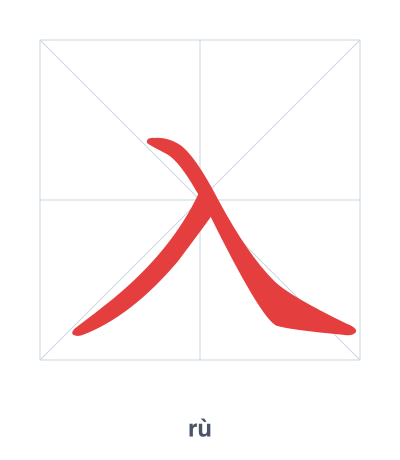
Open Hanzi Writer to see the animated stroke order and practice writing 入 with real-time feedback.
The character 入 (rù) is written with 2 strokes. Follow the standard Chinese stroke order: top to bottom, left to right, outside before inside. The radical 入 is one of its key components.
Practice the correct stroke order with the Hanzi Writer app to see animated stroke-by-stroke guidance with real-time feedback.
入 means to enter / to join.
As an HSK Level 2 character, 入 is among the first characters beginners learn.
入 is a pictograph that originally depicted a pointed arrowhead or a wedge shape, symbolizing something piercing or moving inward. This visual of a sharp point entering a surface directly connects to the character's meanings of 'to enter' or 'to join.'
💡 Memory Tip: Imagine a sharp 'V' shape (入) as a bird diving down to enter a hole in a tree.
超市的入口在哪里?
chāo shì de rù kǒu zài nǎ lǐ
Where is the entrance to the supermarket?
请进入房间休息。
qǐng jìn rù fáng jiān xiū xī
Please go into the room to rest.
他今年九月入学。
tā jīn nián jiǔ yuè rù xué
He starts school this September.
Open Hanzi Writer to see the animated stroke order and practice writing 入 with real-time feedback.
✨ Animated stroke order · Handwriting recognition · HSK-graded practice · Free to use
入 is a simple character that is also its own radical. Its shape, with two strokes meeting at the top like an arrow or a wedge, suggests something moving into a space, which connects to its meanings of 'to enter' or 'to join'.